What Do We Mean By Sustainability?

This page introduces you to the key concepts underpinning sustainability, and is for anyone wanting to learn about sustainability and education for sustainable development.
PSF Alignment: V1, V2, V4, K1,K2, K5
You can develop your learning further in our five related workshops on Sustainability. Find out more on our LTA CPD page.
In clarifying our approach to the theme of Sustainability in this Toolkit, we need to look at some definitions.
Key definitions
Sustainability
Sustainability can be understood in a number of ways.
In Higher Education, ‘sustainability’ is a broad concept that goes beyond just environmental issues. It refers to how universities operate, teach, and contribute to society in ways that are environmentally responsible, socially fair, and economically viable for the long term.

Sustainability in learning and teaching
For Higher Education, it is part of our duty to prepare students to co-shape a more equitable and sustainable future. This involves integration of the idea across all disciplines and contexts in the university.
This might look like;
• Embedding sustainability into courses and teaching practices (such as engaging with wicked problems, the Sustainable Development Goals -SDGs)
• Helping students develop knowledge, skills, and values to tackle global challenges (such as embedding the 8 UNESCO Sustainability Competencies or supporting learners with Problem Based Learning)
• Encouraging critical thinking about issues like climate change, inequality, and resource use (through active learning such as role play, debates and discussions. This can also involve interdisciplinary working)
It also involves our Research and Innovation. For this, we contribute by:
• Conducting research on climate change, renewable energy, and sustainable systems
• Supporting innovation that benefits society and the environment
Beyond this, ‘sustainability’ also applies to how universities run on campuses through:
• Reducing carbon emissions and aiming for net zero targets
• Managing energy, waste, and resources responsibly
• Using campuses as “living labs” for sustainability innovation
It also means taking local and global responsibility, such as:
• Working with local communities and industries
• Promoting global citizenship and ethical awareness
• Supporting policies like the Well-being of Future Generations (Wales) Act 2015, which encourages long-term thinking and collaboration
And, it supports lifelong learning and skills for the future. At Cardiff, a key aim is to produce sustainability-aware graduates who:
• Understand sustainability challenges
• Can solve real-world problems
• Are employable in a green and socially responsible economy
Activity: What does Sustainability mean to you? Add an Image to the Padlet
Reflect on the following:
- What does sustainability mean to you and how does your photo depict this?
- Why is sustainability important to you?
- How should higher education institutions teach about sustainability so that it is inclusive and relevant to everyone?
The 3 Pillars of Sustainability

Reference is often made to the ‘3 Pillars of Sustainability’:
1. Environmental stewardship refers to our physical environment – the biosphere. This includes water, air quality, soil fertility, food sources and nature. It considers the ecosystems that perpetuate our physical environment.
2. Economic efficiency refers to standard of living for all systems. This includes considering carefully any harmful environmental trade-offs that could affect future generations. This also includes energy conservation, reducing carbon footprints and minimising waste. The main concept for economic sustainability is rejecting short-term processes and considering the planet’s long-term well-being.
3. Social responsibility refers to treating everyone fairly by ensuring equity. This also links to social justice, which considers how the structures of society support fair social systems and targets issues that hinder this. In addition, the social aspect of sustainability involves maintaining the health and well-being of people and communities.
Sustainable Development

International and national policies from the late 1980s have shifted the focus away from the environmental movement and pollution concerns of the 1970s, where the main goal was on protecting the natural environment, towards ‘sustainable development’.
A widely cited definition of ‘sustainable development’ comes from the 1987 report of the World Commission on Environment and Development (WCED), commonly known as the Brundtland Report.
‘Sustainable development is development that meets the needs of the present without compromising the ability of future generations to meet their own needs.’
See the UN Sustainable Development Goals (SDGs) or the Why Sustainability? page for more on this.
Education for Sustainable Development (ESD)
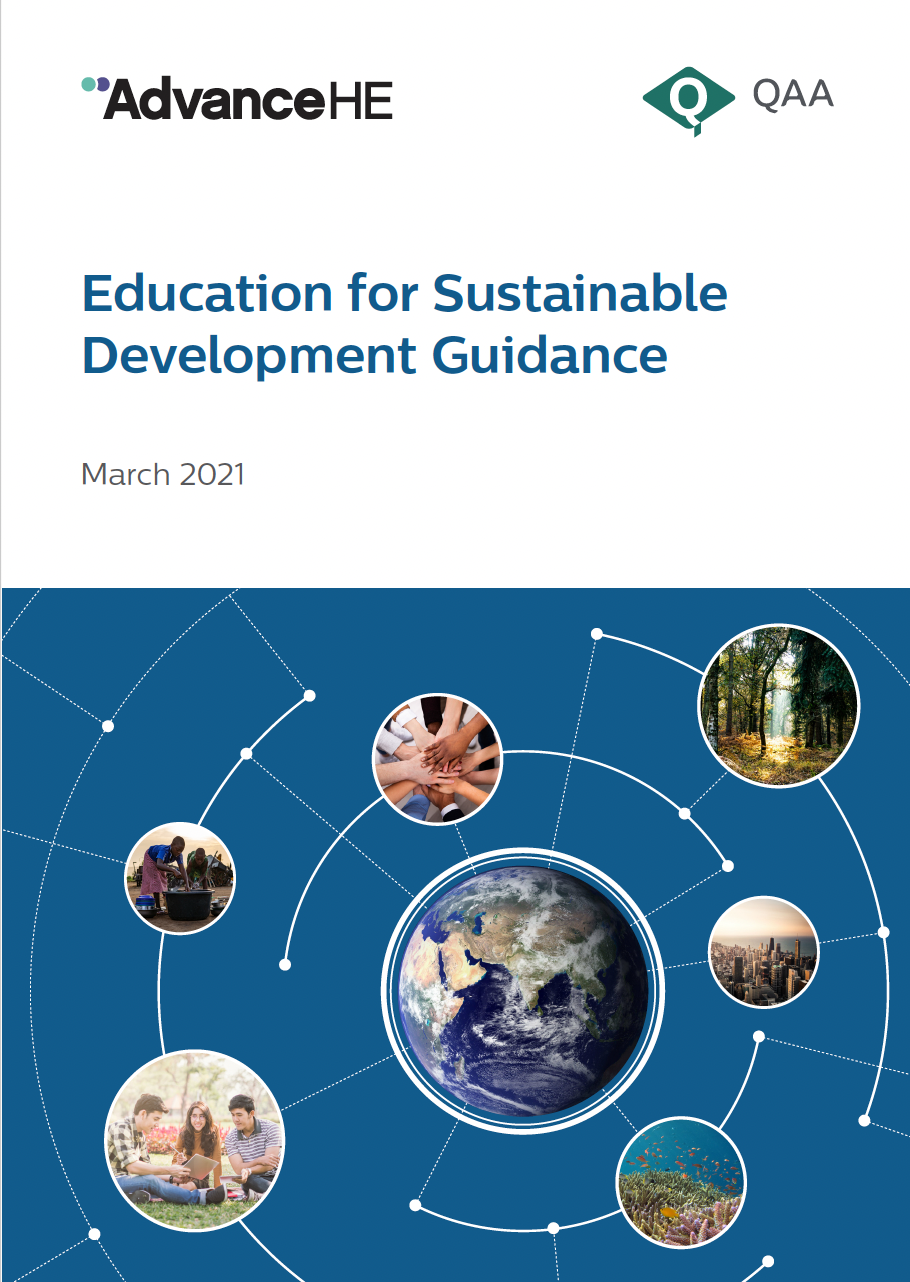
‘Education for Sustainable Development’ (ESD) has largely taken the place of traditional environmental education in policies and academic discussions.
Unlike environmental education, which is more focused on nature and ecosystems (ecocentric), ESD takes a holistic approach that focuses on human well-being, including issues such as poverty and social inequality.
ESD is interdisciplinary, meaning it draws from multiple fields of study, and emphasises teaching skills and critical thinking to help individuals take meaningful action towards creating a more sustainable society.
ESD also requires subjective interpretation and involves making value judgments, as it deals with complex and often controversial issues.
ESD aligns with a view of knowledge as multi-faceted, evolving through interactions and shaped by our ever-changing world.
See the QAA / Advance HE Education for Sustainable Development Guidance, or the Why Sustainability? page for more on this.
Where next?
Link to other toolkit pages
You can read more about sustainability on the subsequent pages: Why Sustainability?, Embedding Sustainability in Learning and Teaching, and also read more about Cardiff University Education for Sustainable Development projects in our extensive case studies collection.
Additional resources and references
Dawe, G., Jucker, R., and Martin, S. (2005). Sustainable development in higher education: Current practice and future developments. A report for the Higher Education Academy: York.
Future Generations Wales (2022) ‘Well-being of Future Generations (Wales) Act 2015’. Future Generations Wales. Available from : https://www.futuregenerations.wales/about-us/future-generations-act/ [Accessed on 28/10/24]
Parkin, S., Johnson, A., Buckland, H. and White, E. (2004), Learning and Skills for Sustainable Development: Developing a Sustainability Literate Society, HEPS, London.
QAA and Advance HE (2021) ‘Education for Sustainable Development Guidance’. [online pdf] The Quality Assurance Agency for Higher Education and Advance HE 2021
Sterling, S (2001). Sustainable Education. Devon, England: Green Books
Tilbury, D. and Wortman, D. (2004) Engaging People in Sustainability, IUCN – The World Conservation Union, Gland, Switzerland.
UNESCO (2020) Education for Sustainable Development: a roadmap. Available from: https://unesdoc.unesco.org/ark:/48223/pf0000374802.locale=en
UNESCO (2022) What you need to know about education for sustainable development | UNESCO
Welsh Government (2009) ‘One Wales: One Planet. The Sustainable Development Scheme of the Welsh Assembly Government’. Welsh Government publication. Available from: https://www.bridgend.gov.uk/media/1505/wd32.pdf [Accessed on 31/08/22]
Welsh Government (2019) ‘Wales and the Sustainable Development Goals: Supplementary Report to the United Kingdom of Great Britain and Northern Ireland Voluntary National Review of progress towards the Sustainable Development Goals 2030’. Welsh Government publication. Available from: https://gov.wales/sites/default/files/publications/2019-07/supplementary-report-to-the-uk-review-of-progress-towards-the-sustainable-development-goals-2030_0.pdf [Accessed on 31/08/22]
Welsh Government (2021) ‘The Co-operation Agreement’. Welsh Government publication. Available from: The Co-Operation Agreement (gov.wales) [Accessed on 31/08/22]
Page Authored by: Cardiff University Learning and Teaching Academy: Dr Laura Barritt