Introduction to Inclusive Education
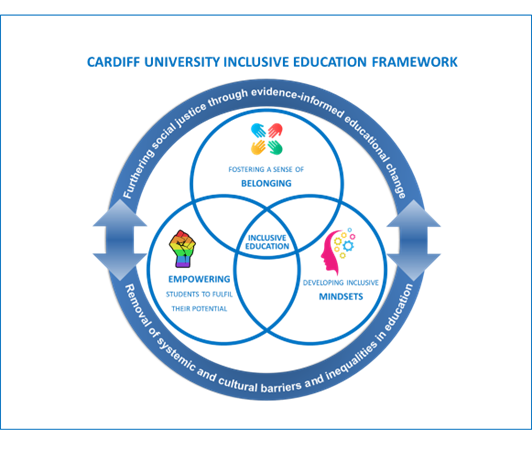
This page introduces you to the core principles and areas of focus of the Cardiff University Inclusive Education Framework, before considering the diversity of our students.
It is designed for those who want to know more about the Cardiff University Inclusive Education Framework, and for those who are new to teaching or to inclusive education, perhaps working at an Associate Fellow or Fellow level.
Aligned to PSF: V1 and V2
You can develop your understanding of Inclusive Education by engaging with our related workshop, ‘Introduction to Inclusive Education’. Find out more on the Cardiff LTA CPD page.
What is Inclusive Education?
Cardiff University recognises Hockings’ (2010, p1) definition of inclusive education which ‘refers to the ways in which pedagogy, curricula and assessment are designed and delivered to engage students in learning that is meaningful, relevant and accessible to all. It embraces a view of the individual and individual difference as the source of diversity that can enrich the lives and learning of others.’
Inclusive Education is a dynamic process requiring institution-wide commitment to a systematic transformation of the culture, processes and practices of the university, overcome barriers to the presence, participation, achievement and experience of all students, and to account for and celebrate the rich diversity of the learning community.
Inclusivity is central to providing learning that is meaningful, relevant and accessible to all. It is a core part of a thriving university and recognises that every member of our community brings unique experiences, identities and perspectives that enrich our shared learning.
Our approach to Inclusive Education: the Cardiff University Inclusive Education Framework
This university-wide framework is designed to help schools and departments embed inclusive education in their work, so that inclusive principles are part of our everyday teaching and wider educational development.
Key Principles
Central to our approach is our commitment to furthering social justice through evidence-informed educational change and the removal of systemic and cultural barriers and inequality.
Our three areas of focus:
Fostering a sense of belonging
Students flourish in a culture which recognises and celebrates diversity to develop a sense of belonging for all staff and students: belonging is “one's personal belief that one is an accepted member of an academic community whose presence and contributions are valued” (Good et al. 2012). Our five areas of focus to help foster a sense of belonging are:
- Recognising and celebrating our diverse university community, and enabling students to see themselves represented in the curriculum
- Challenging the hidden curriculum and providing proactive and connected support for students through the learning journey
- Actively seeking, listening and responding to all voices
- Being transparent, timely and compassionate in our communications
- Developing a sense of community and identity within the University, School, Programme and/or discipline
Empowering Students to Fulfil their Potential
The Well-being of Future Generations (Wales) Act 2015 aims for 'a society that enables people to fulfil their potential no matter what their background or circumstances.' At Cardiff University we will support all students to achieve their potential through the following five key areas:
- Providing learning that is authentic, meaningful and relevant by recognising the needs and perspectives of all learners, and designing for all
- Supporting all students to fully participate in learning activities
- Enabling all students to demonstrate their abilities, skills and knowledge
- Tailoring our support for students by proactively reaching out to offer personalised support and enabling all students to improve their outcomes
- Equipping students with the skills and strategies they need to succeed both during their studies and beyond
Developing Inclusive Mindsets
An inclusive community actively engages with the challenges and complexities of belonging and achievement inherent in traditional and elitist practices. It strives to overcome them through identification of barriers to learning and engagement, to enhance the move to 'A more equal Wales' (Well-Being of Futures Generations Act 2015). Through developing inclusive mindsets, we can support and empower students from all backgrounds to celebrate diversity, and to become agents and change-makers who can actively participate in supporting the development of socially just futures (UN Sustainable Development Goal 16).
- Drawing on the diversity of the community to enrich and inform the development of the student experience
- Recognising and articulating inequalities and privilege, including critiquing understandings of the origins of subject knowledge
- Inspiring students to become champions of inclusivity, equipping them with the skills to foster and support inclusive environments
- Empowering students to become resilient, critical, problem-solving change- makers who can collaborate with others in an uncertain, interdisciplinary, and digitalised world
- Equipping students with the skills and confidence they need to engage meaningfully in professional and societal roles beyond graduation
The Diversity of our Students
Higher Education is more diverse than it has ever been. Participation in Higher Education of UK domiciled people, and therefore diversity, has risen dramatically since 1950, when less than 5% of the population went to university. This expansion of the higher education system to approximately 50% of UK school and college leavers has resulted in much greater student diversity. This has been further enhanced by internationalisation, widening participation agendas, and rising numbers of disabled students, making it more imperative than ever to consider our inclusive education.
What do the students say?
An important first step is understanding who our learners are, to enable us to reflect upon how we can best teach and support them. We worked with a range of Undergraduate, Postgraduate, international and home students with multi-faceted identities, backgrounds and experiences from across Cardiff University. Throughout the inclusivity pages and sections, you will find videos, perspectives and quotes.
Here are some reflections on inclusivity and EDI from our students:
The Dimensions of Diversity
It is important to understand, respond to, and celebrate the rich diversity of our students and this ‘requires attention to the complex, dynamic, and intersecting identities that all learners and teachers bring to the pedagogical experience’ (Lawrie et al. 2017).
In thinking about diversity, we adopt a broad definition, utilising Thomas and May’s (2010) conceptualisation of four broad dimensions of diversity by which all students (and staff) may differ: educational, dispositional, circumstantial and cultural.

Figure 2: Dimensions of Diversity (Thomas and May 2010)
Whilst some of these characteristics are recognised in the Equality Act 2010 as protected, and some may be eligible for additional support from particular university services (such as disability), student needs are more varied than these categories. All of the dimensions above require us to consider the design of our teaching and our practices, to ensure all students have an equitable experience.
The Equality Act (2010) also requires us to be anticipatory in our educational provision: therefore, we cannot wait until a student presents with a particular learning need or characteristic. Rather, we must design our adjustments from the outset, to cater for the majority of needs.
To explore the diversity of your students, you can access our workshop on diversity data (staff only). It enbales you to explore the student characteristics and diversity data of your programme through access to BI and personas, which are archetypes that characterise the needs, goals, technical experience, accessibility requirements and other personal characteristics of larger groups of people (Lilley, Piper and Attwood 2015). These can provide colleagues with an enhanced understanding of the student population and identify key characteristics to be taken into account during the student lifecycle, and the teaching cycle of design, delivery, assessment and evaluation.
To find out more about Personas, access this Xerte learning resource:
Where next?
To learn more, you can access the next three sections of the inclusivity theme: Fostering a Sense of Belonging, Empowering Students to Fulfil their Potential, and Developing Inclusive Mindsets. You can also read about inclusivity as applied to your practice in each section: Design; Teaching Approaches; Assessment and Feedback; and Evaluation and Collaboration.
Additional resources and references.
Hockings, C. 2010. Inclusive Learning and Teaching in Higher Education: A Synthesis of Research. York: Higher Education Academy. Available Online
Lawrie, G., Marquis, E., Fuller, E., Newman, T., Qui, M., Nomikoudis, M., Roelofs, F., & van Dam, L. (2017) Moving towards inclusive learning and teaching: A synthesis of recent literature. Teaching and Learning Inquiry 5 (1)
Thomas, L. and May, H. 2010. Inclusive Learning and Teaching in Higher education. York: HEA. Available online
The Well-Being and Future Generations Act and UN Sustainable Development Goals: See our Sustainability theme
Page Authored by: Cardiff University Learning and Teaching Academy: Dr Ceri Morris