Assessment and Feedback Literacy and Inclusive Approaches
Assessment and feedback are central to student learning, yet students often find assessment expectations difficult to interpret and feedback challenging to understand and act upon. Assessment and feedback literacy help students understand what success looks like, engage meaningfully with assessment processes, and use feedback to improve future performance. Research suggests that these capabilities are developed gradually through purposeful learning activities, dialogue and reflection, rather than through feedback comments alone.
In addition, in order for HE institutions to comply with the Equalities Act 2010, when considering assessment, institutions should design assessments that are both anticipatory and inclusive. Inclusive universally-designed assessment processes provide for all students whilst also meeting the needs of specific groups.
This page is designed for staff who design assessments, provide feedback, support learning, or lead enhancement activities within modules and programmes. Whether you are new to teaching or leading assessment enhancement initiatives within your School, this page provides practical approaches that can be adapted to a wide range of disciplines and contexts.
Aligned to PSF: V1, V2, V5,K2, K3, K5, A3
You can develop your understanding of Inclusive Education by engaging with our related workshop, ‘Enhancing Assessment and Feedback Literacy for Staff and Students’ Inclusive Assessement and Feedback is covered in our Embedding Inclusive Education in your Practice: Designing, delivering and assessing learning for all and Enhancing Academic Feedback, Inclusive Feedback workshops. Find out more on the Cardiff LTA CPD page.
Assessment and Feedback Literacy
Understanding the Student Experience
Students regularly report uncertainty about assessment expectations, standards and feedback practices. Many describe difficulties understanding assignment requirements, applying marking criteria and interpreting feedback comments. These experiences can reduce confidence, engagement and ultimately performance.
What do we mean by Assessment and Feedback Literacy?
Assessment and feedback literacy are closely connected concepts.
Assessment Literacy
Assessment Literacy helps students understand:
- Assessment requirements
- Standards and criteria
- Marking processes
- What succeccful work looks like
Price et al. (2012)
Feedback Literacy
Feedback literacy helps students:
- Recognise and appreciate feedback
- Manage emotional responses
- Take action
- Make evaluative judgements
Carless & Boud (2018)
Research suggests that assessment and feedback literacy are associated with improved self-regulation, increased confidence and greater ability to apply feedback across learning contexts. Students are more likely to benefit from assessment and feedback when they are supported to understand standards, evaluate quality and use feedback to improve future work. Developing assessment and feedback literacy helps students become active participants in their own learning (Carless & Boud, 2018).
Developing Assessment and Feedback Literacy
Assessment and Feedback Strategies
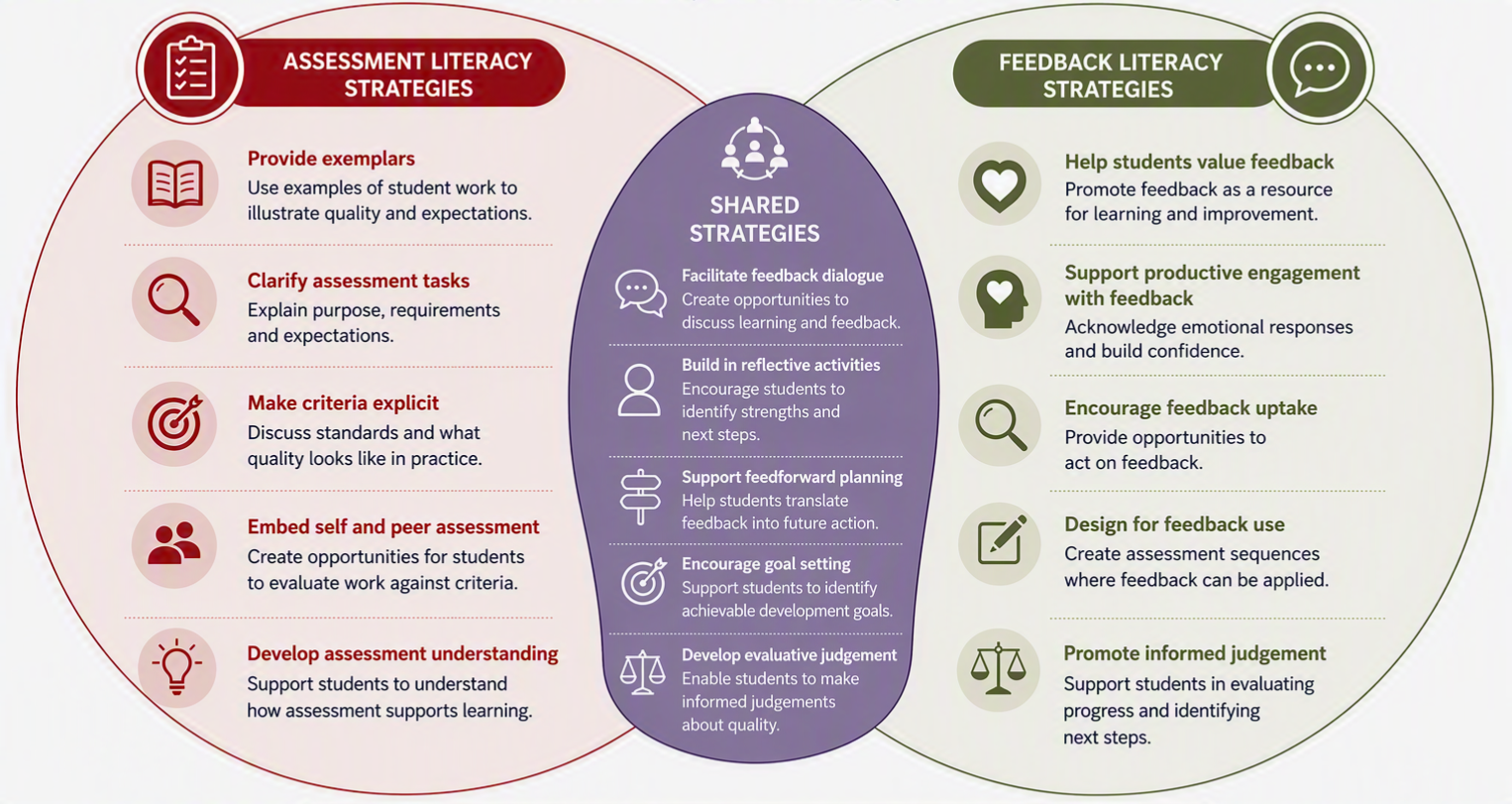
Assessment and feedback literacy develop gradually through purposeful learning activities, dialogue and reflection. The diagram below presents implementable, evidence-informed strategies that can be adapted across disciplines and teaching contexts. The overlap highlights practices that can help develop both forms of literacy.
Using the Strategies in Practice
Evaluative judgement: ‘Developing evaluative judgement helps students recognise quality in their own work and the work of others, supporting more effective use of feedback ‘ (Tai et al., 2018).
You do not need to use every strategy at once. Start by identifying one aspect of assessment or feedback that students find challenging, then choose one or two relevant strategies to build into an existing teaching, assessment or feedback activity.
To explore these strategies in more depth, the supporting Assessment & Feedback Literacy CPD session offers worked examples, structured discussion and opportunities to apply them within your own disciplinary context. You can access the asynchronous content or sign up for the live session in the Further Support section at the bottom of this page.
Design Feedback Students Can Use
Feedback as a Learning Process
Feedback is not simply information transmitted to students. Effective feedback is a process through which students make sense of information and use it to improve future learning. To maximise impact, feedback should support feed forward by helping students identify how learning from one task can be applied to future assessments and learning activities.
The Seven Hallmarks of Effective Feedback
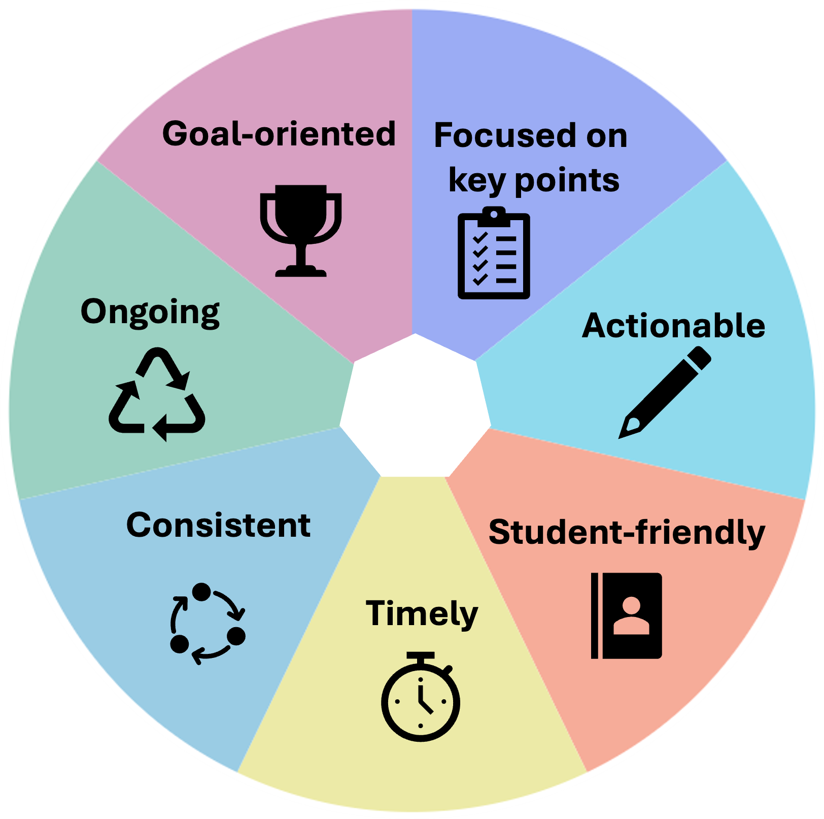
Effective feedback is not simply information transmitted to students. It should help students understand performance, make sense of advice and apply learning to future work. The seven hallmarks below provide a practical framework for designing feedback that students can understand, engage with and use (Winston & Carless, 2020).
Workload-Aware Feedback
Better feedback does not necessarily mean more feedback. Enhancement may come from:
- Reducing repeated comments
- Improving consistency
- Improving clarity
- Supporting action
- Selecting appropriate feedback modes
Choosing Appropriate Feedback Formats
Feedback can be delivered in different ways. The most appropriate format will depend on the purpose of the task, the needs of the cohort, available time and how students are expected to use the feedback.
Written feedback is clear, accessible and easy to revisit. Written feedback works well for identifying strengths, areas for improvement and specific next steps, especially when linked to assessment criteria.
Best suited for:
- Detailed comments linked to assessment criteria
- Identifying specific strengths and areas for improvement
- Providing actionable next steps
- Feedback that students may need to revisit multiple times
Evidence-informed insight:
Students are more likely to engage with feedback when comments are specific, understandable and clearly connected to future improvement rather than simply justifying a grade (Winstone & Carless, 2020).
Audio feedback adds tone, nuance and encouragement. It can help explain complex points more naturally and may feel more personal for students.
Best suited for:
- Explaining nuanced or complex issues
- Providing encouragement and reassurance
- Offering holistic commentary on a piece of work
- Building a more conversational feedback experience
Evidence-informed insight:
Research suggests that students often perceive audio feedback as more personal and supportive, whilst retaining many of the benefits of written feedback (Ice et al., 2007).
Video feedback can combine spoken explanation with visual demonstration. It is particularly useful when discussing visual artefacts, design work, presentations or practical tasks.
Best suited for:
- Visual or creative assignments
- Demonstrating processes and techniques
- Reviewing design decisions or practical work
- Showing examples alongside commentary
Evidence-informed insight:
Video feedback can help students contextualise feedback by combining visual cues and explanation, making it easier to demonstrate concepts and processes (Mahoney, Macfarlane & Ajjawi, 2019).
Automated feedback provides immediate responses at scale and is particularly valuable in formative learning activities where students can apply feedback before final submission.
Best suited for:
- Knowledge checks and quizzes
- Practice activities
- Developing procedural knowledge
- Supporting self-paced learning
Evidence-informed insight:
Immediate feedback can promote self-regulated learning by helping students identify misunderstandings and take corrective action while learning is still in progress (Nicol & Macfarlane-Dick, 2006).
Cohort-based feedback addresses common strengths, misconceptions and recurring issues across a group. It can reduce repetition while supporting consistency and efficiency. This can take multiple forms, written, audio, or video.
Best suited for:
- Large cohorts
- Highlighting common misconceptions
- Sharing examples of good practice
- Reinforcing assessment expectations
Evidence-informed insight:
Providing feedback to groups can encourage collective reflection, support shared understanding of standards and help students identify common approaches to improvement (Nicol, 2010).
The Key Principles of Effective Assessment and Feedback
- ✔Work in partnership with students ⇒ Discuss assessment and feedback openly.
- ✔Focus on Assessment for Learning ⇒ Use assessment as a learning opportunity, not simply a measurement tool. Give students an opportunity to fail.
- ✔Design feedback for action ⇒ Ensure students have opportunities to apply feedback from feed forward comments.
- ✔Develop evaluative judgement ⇒ Enable students to recognise quality and make informed judgements.
- ✔Take a programme-level approach ⇒ Build A&F literacy progressively across modules and years of study.
Authored by: LTA, Michael Lang
Inclusive Assessment and Feedback

Inclusive Assessment and Feedback enables all students to demonstrate their abilities, skills and knowledge, one of the key areas of focus in ’empowering students to fulfil their potential’ in the Inclusive Education Framework, above. The Cardiff University Inclusive Education Enhancement Model has a series of key targets for enhancing assessment and feedback. Enhancement Model Targets for Assessment and Feedback at a Session or Module Level are:
- Modules provide learning activities and formative assessments that build students’ skills and understanding in the discipline ready for summative assessments.
- Module team(s) design and review assessments to ensure no obvious barriers to learning are created for groups of students and anticipate barriers by applying Universal Design for Learning principles to help ‘design out ‘ the need for individual adjustments.
- Assignment briefs, criteria and guidance are well designed, and all students are clear of the requirements and understand expectations of a high grade.
- Most modules plan alternative assessments from the outset providing assessment criteria and eligibility to all students.
- Module teams agree a feedback strategy and terminology to be used in feedback. Feedback is personalised to the content, and is clear and concise, relates to assessment criteria and is constructive and actionable.
Principles of Inclusive Assessment
There are a series of specific recommendations for the programme-level design of inclusive assessment (Advance HE 2018: Tai et al. 2019). Programmes should employ:
- A range of assessment approaches that are accessible, non-discriminatory and timely.
- A range of feedback approaches that are accessible, interactive, ongoing and timely.
- Incorporation of student choice in assessment practices.
- Opportunities to critically engage with equality, diversity and inclusivity themes in assessments that relate to authentic real-life scenarios.
- Preparation, engagement and support of students throughout the assessment process that develops their assessment literacy.
- Opportunities for students to act as partners in the assessment and feedback process.
- A programme-level approach to the design, development, understanding and coordination of assessment and feedback practices.
- Routine monitoring, review and sharing of assessment practices that embed equality, diversity and inclusivity.
Assessment and Culturally Sustaining Pedagogy
As a social construct, assessment could be said to comprise practices and processes in which specific values and practices are reflected and enshrined, such as (in the UK at least) rationality, individuality, objectivity and written capabilities. Recent work on inclusion and universal design of assessment has focussed on the imperative to consider the socially constructed nature of assessment, through the lens of Culturally Sustaining Pedagogy (CSP) (Hanesworth et al. 2019).
Assessment forms and practices are created through unquestioned and habitual use, are normalised and can marginalise and exclude certain students and cohorts for whom such practices are unfamiliar or inaccessible (Bass and Lawrence-Riddell 2020).
Assessment can also be seen to hierarchise knowledge: in our inevitable selection of content for assessments, we subconsciously communicate to learners what disciplinary knowledge is important or valuable, and what is not. Assessment is indivisible from individual value judgements: designed and evaluated by us, with all our complex socio-cultural backgrounds, educational experiences and intellectual and personal values. It is therefore subject to our biases.
Reasonable Adjustments for Disabled Students
We have a duty under the Equality Act to make reasonable adjustments to our assessments, for disabled students, once agreed by the School. There is a specific policy and guidance for staff teaching undergraduate and PGR students to support you in this.
Reasonable adjustments should not compromise the academic standards of programmes or modules, as the Equality Act places no duty to make a reasonable adjustment to a competence standard. A competence standard is ‘an academic, medical, or other standard, applied for the purpose of determining whether a person has a particular level of competence or ability’. A competence standard must apply equally to all students, be genuinely relevant to the programme, and be a proportionate means to achieving a legitimate aim.
There is however a duty to make reasonable adjustments to the way in which a competence standard is assessed so that disabled students are not disadvantaged as a result of their disability. Reasonable adjustments must not affect the validity or reliability of the assessment outcomes. However, they may involve, for example, changing the usual assessment arrangements or method, adapting assessment materials, providing a scribe or reader in the assessment, and re-organising the assessment environment
Alternative Assessments
Alternative Assessments are provided when, for some reason, a student cannot complete the assessment designed for the module or programme. This might be because of a disability, and be the reasonable adjustment required. Alternatively, it might be because of a short-term issue for the student, for example sudden ill health or bereavement, requiring an alternative remedy.
When designing your module, consider what alternative assessments might be required in these scenarios, and design these from the outset. This ensures you are being anticipatory in your design to comply with the Equality Act. Ensure you prepare assessment guides, marking criteria or rubrics for all forms of assessment, and explain the eligibility for alternative assessments to students.
Choice in Assessment
Choice in assessment can take many forms: choice of topic, modes (such as written, presentation, multi-media) or scope, such as individual or team work. While choice of topic may be more familiar, the option of choice in mode has been seen as more challenging to our organisational structures and processes, despite the potential to provide for Universal Design for Learning through multiple means of action and expression.
Recent post-pandemic publications support choice in assessment mode, highlighting how positive changes made during the pandemic enabled the introduction of diversity and choice in assessment, and exploring how these might be sustainable in the future through changes to assessment principles and practices, and through collaborating on a programmatic approach to assessment (Padden and O’Neil 2021).
In relation to student choice in assessment mode, research highlights the complexity of issues surrounding the implementation of student choice. Despite these complexities, O’Neil (2017) highlighted the positive impact of a limited choice for students, with the attainment of higher grades than those achieved by previous student cohorts who did not experience choice. Similarly, Hockings’ seminal review of the literature (2010: 21) suggested that having choice in assessment mode enables students to deliver evidence of their learning in a medium that suits their needs, rather than in a predetermined and prescribed format, which may disadvantage an individual or group of students in the cohort. Research on student choice in assessment by Cardiff University highlighted similar themes (Morris, Milton and Goldstone 2019).
Where next?
Link to other toolkit pages
Our three key areas of focus of Fostering a Sense of Belonging, Empowering Students to Fulfil their Potential, and Developing Inclusive Mindsets are in the Inclusivity themes section of this toolkit. You can go on to read more about Assessment and Feedback in the rest of this section.
Additional resources and references
Helpful Resources:
The Learning and Teaching Academy also provides support through:
- Programme design consultation
- Assessment enhancement support
References
Advance HE 2018. Embedding EDI in the Curriculum: A programme standard. Online. Available at: https://www.advance-he.ac.uk/sites/default/files/2019-09/Assessing%20EDI%20in%20the%20Curriculum%20-%20Programme%20Standard.pdf
Bass, G. and Lawrence-Riddell, M. 2020. Culturally Responsive Teaching and UDL https://www.facultyfocus.com/articles/equality-inclusion-and-diversity/culturally-responsive-teaching-and-udl/
Carless, D. and Boud, D. (2018) ‘The development of student feedback literacy: enabling uptake of feedback’, Assessment & Evaluation in Higher Education, 43(8), pp. 1315-1325. Available at: https://doi.org/10.1080/02602938.2018.1463354.
Hanesworth, P. Seán Bracken & Sam Elkington (2019) A typology for a social justice approach to assessment: learning from universal design and culturally sustaining pedagogy, Teaching in Higher Education, 24:1, 98-114
Ice, P., Curtis, R., Phillips, P. and Wells, J. (2007) ‘Using asynchronous audio feedback to enhance teaching presence and students’ sense of community’, Journal of Asynchronous Learning Networks, 11(2), pp. 3-25.
Mahoney, P., Macfarlane, S. and Ajjawi, R. (2019) ‘A qualitative synthesis of video feedback in higher education’, Teaching in Higher Education, 24(2), pp. 157-179.
Morris, C. Milton, E. and Goldstone, R. 2019 Case study: suggesting choice: inclusive assessment processes, Higher Education Pedagogies, 4:1, 435-447
Nicol, D. (2010) ‘From monologue to dialogue: Improving written feedback processes in mass higher education’, Assessment & Evaluation in Higher Education, 35(5), pp. 501-517.
Nicol, D. and Macfarlane‐Dick, D. (2006) ‘Formative assessment and self‐regulated learning: a model and seven principles of good feedback practice’, Studies in Higher Education, 31(2), pp. 199-218.
Padden, L. and O’Neill, G. 2021. Embedding equity and inclusion in higher education assessment strategies: creating and sustaining positive change in the post-pandemic era. In: Baughan, B. 2021. Assessment and Feedback in a Post-Pandemic Era: A Time for Learning and Inclusion. Advance HE: https://www.advance-he.ac.uk/knowledge-hub/assessment-and-feedback-post-pandemic-era-time-learning-and-inclusion
Price, M., Rust, C., O’Donovan, B., Handley, K. and Bryant, R. (2012) Assessment literacy: the foundation for improving student learning. Wheatley, Oxford: Oxford Centre for Staff and Learning Development (OCSLD), Oxford Brookes University.
Tai, J., Ajjawi, R., Bearman, M., Boud, D., Dawson, P., & Jorre de St Jorre, T. (2023). Assessment for inclusion: rethinking contemporary strategies in assessment design. Higher Education Research & Development, 42(2), 483–497. https://doi.org/10.1080/07294360.2022.2057451
Winstone, N. & Carless, D. (2020). Designing Effective Feedback Processes in Higher Education: A Learning-Focused Approach.
There is an exhaustive inventory of Universal Design “places to start” in the form of a long list of Universal Design suggestions, organised according to some of the different modes of “delivery” or styles of teaching in higher education. The idea is to try any of these suggestions out in your own classroom, and see where they go. From: Dolmage, J. T. Academic Ableism: disability and Higher Education. University of Michigan Press.
Inclusive Assessment Authored by: Cardiff University Learning and Teaching Academy: Dr Ceri Morris