Education Development Toolkit
The Cardiff University Education Development Toolkit provides guidance for staff in developing outstanding educational practices and consistently high-quality student learning experiences, that support all students to fulfil their potential. It is evidence-based and full of practical tips, reflections, student voice and case studies, covering a wide range of important learning and teaching themes, including our cross-cutting themes of inclusivity, sustainability and employability.
The resource aligns to the strategic goals set out in the ‘Our Future, Together’ strategy, to help us to realise our ambitions to be a university offering ‘an excellent educational experience for students of all backgrounds and experiences, and a commitment to flexible lifelong learning that creates positive change.’ It was been developed in 2021, and re-developed in 2026 through collaboration with academics, professional services and education specialists across Cardiff University.
The Toolkit Approach
 The toolkit uses a Universal Design for Learning format with short texts, images and videos, and boxes with student voice, case studies from Cardiff University and elsewhere, and activities for reflection.
The concepts and discussion presented within the toolkit are indicative, and are not intended to be prescriptive or comprehensive.
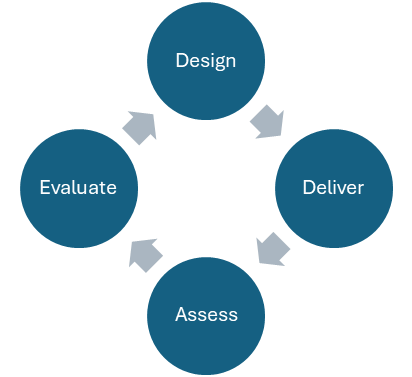
The toolkit is not designed as a ‘cover to cover’ read! Navigate to the sections that are of most interest or use to you – such as Cardiff University’s cross-cutting education themes (inclusivity, employability and sustainability), or the key education principles, which follow the teaching cycle: design for effective learning, teaching approaches (delivery), assessment and feedback for learning, and evaluation, collaboration and engagment.
Menu
Explore our cross-cutting themes
Explore guidance and resources to help embed inclusivity, employability and sustainability across learning, teaching and curriculum design.
Inclusivity
- Introduction to Inclusive Education
- Fostering a Sense of Belonging
- Empowering Students to Fulfil Their Potential
- Developing Inclusive Mindsets
Employability
- Student Futures Framework
- 9 Skills for Success
- Programme Approval and Revalidation
- Embedding Employability in the Curriculum
Sustainability
- What Do We Mean by Sustainability?
- Why Sustainability?
- Embedding Sustainability in Learning and Teaching
- Sustainability Case Studies
Explore the teaching cycle
Explore guidance and resources across the teaching cycle, from designing effective learning, and teaching approaches, through to assessment and feedback, evaluation, student engagement and collaboration.
1. Design for Effective Learning
- Inclusive Design
- Programme Scoping
- Programme Development
- Module and Session Design
- Designing a Coherent Learning Journey and ABC Learning Design
2. Teaching Approaches
- Inclusive Teaching Approaches
- Teaching Approaches for Engagement and Learning
- Learning Design in Practice: Designing Effective Flipped Learning
- Key Teaching Approaches: Empathetic Pedagogy, Play and Games
3. Assessment and Feedback (A & F) for Learning
- Assessment and Feedback Literacy and Inclusive Approaches
- Programme-level Design of A&F (including Cardiff EAT and Gen AI)
- Learning Design for A & F: Preparing and Running Assessments
- Approaches to A&F (including Authentic Assessment and Teamwork)
4. Evaluation, Collaboration and Engagement
- Evaluation: Actively Seeking, Listening and Responding to All Voices
- Collaboration and Co-construction
- Student Engagement
- Collaboration with Staff: Inclusive Leadership
- Designing Beyond Blended: Using the Six Pillars
Professional Standards Framework (PSF 2023)
The introduction to each of the sections and pages identifies the links between the content and the dimensions of the Advance HE PSF 2023. The Professional Standards Framework brings together three related dimensions: Professional Values, Core Knowledge and Areas of Activity. You can read the full Advance HE “Professional Standards Framework for teaching and supporting learning in higher education” 2023 here.
Professional Values
In your context, show how you:
V1 – respect individual learners and diverse groups of learners
V2 – promote engagement in learning and equity of opportunity for all to reach their potential
V3 – use scholarship, or research, or professional learning, or other evidence-informed approaches as a basis for effective practice
V4 – respond to the wider context in which higher education operates, recognising implications for practice
V5 – collaborate with others to enhance practice
Core Knowledge
In your context, apply knowledge of:
K1 – how learners learn, generally and within specific subjects
K2 – approaches to teaching and/or supporting learning, appropriate for subjects and level of study
K3 – critical evaluation as a basis for effective practice
K4 – appropriate use of digital and/or other technologies, and resources for learning
K5 – requirements for quality assurance and enhancement, and their implications for practice
Areas of Activity
In your context, demonstrate that you:
A1 – design and plan learning activities and/or programmes
A2 – teach and/or support learning through appropriate approaches and environments
A3 – assess and give feedback for learning
A4 – support and guide learners
A5 – enhance practice through own continuing professional development
Help us improve the Education Development Toolkit
The Toolkit will continue to evolve over time. You can help shape its development by sharing what works well, what could be improved, and which additional topics you would like it to cover via the Microsoft Form linked below. Your feedback will help us improve the resource for everyone.