Empowering Students to Fulfil their Potential
‘Empowering students to fulfil their potential’ is one of the three dimensions of the framework, as a core driver is The Well-Being Future Generations (Wales) Act 2015, which aims for ‘a society that enables people to fulfil their potential no matter what their background or circumstances’.
PSF Alignment: V1, V2, V4, K1, K2, A4
 The Inclusive Education Enhancement model has a number of areas of focus for empowering students to fulfil their potential, to further support your self-reflection and development. You can develop your understanding of Empowering Students to Fulfil their Potential by engaging in our related workshops: Universal Design for Learning, Embedding Inclusive Education, Disability and Reasonable Adjustments, and Supporting International Students. Find out more on the Cardiff LTA CPD page.
What do our students say?
Our students suggested a range of considerations for empowering students:
Universal Design for Learning (UDL)
The Equality Act 2010 requires anticipatory design, and findings on inclusion in extensive research suggest that one solution is to design universally for learning, to enable the agency and meet the needs of the majority of students, rather than retrospectively making adaptations to accommodate specific students, and to ensure all are empowered to fulfil their potential (see Lawrie et al.’s systematic review of the literature). The following video provides an introduction to UDL.
Universal Design for Learning (UDL) is a set of principles for curriculum development that give all individuals equal opportunities to learn. The goal of UDL is learner agency that is purposeful and reflective, resourceful and authentic, strategic and action-oriented (CAST 2024). UDL provides a blueprint for creating teaching goals, methods, materials, and assessments that work for everyone – not a single, one-size-fits-all solution but rather a flexible approach that means learning can be customised and adjusted for individual identities and needs (UDL on Campus 2022).
UDL aims to change the design of the environment rather than to situate the problem as a perceived deficit within the learner. The table in the Figure below presents the outline of the Universal Design for Learning Guidelines 3.0, the full version of which can be found on the UDL Guidelines website.
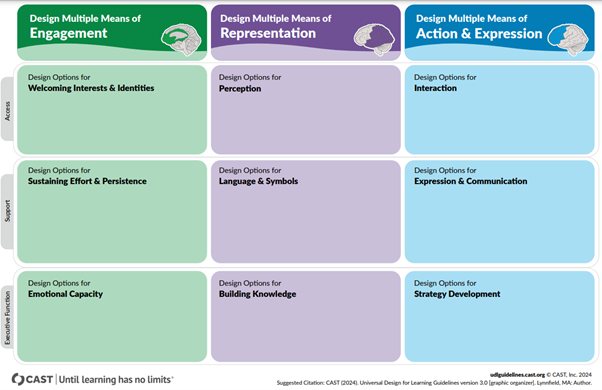
Figure: The UDL Guidelines 3.0. (A screen-readable alternative to the above table is available on this CAST page).
To access a ‘prompt sheet’ to support your development of UDL teaching, download this document. You can develop your understanding of UDL further by engaging with our related workshop, which contains much more detail, and is available asynchronously, or live. Find out more on the Cardiff LTA CPD page.
Remember: Inclusion is a process. Not all of the bullet points will be relevant to our discipline, our teaching, or our student diversity characteristics. Even one small change, such as ensuring a diversity of representation in your resources, making materials available 48 hours in advance, providing a glossary, or catch-up materials and recordings for those who miss opportunities for social learning can change the experience of our students. Plan for quick wins and longer term goals!
Anti-Racist Pedagogy
“The only way to undo racism is to consistently identify it and describe it–and then dismantle it.” (Kendi 2019)
There has been acknowledgement of institutional and systematic racism within society since the death of George Lloyd Floyd in 2020 and the Black Lives Matters movement, which ignited a call to action for society as a whole to become actively anti-racist.
Anti-racist pedagogy is a process of ongoing critical self-reflection, learning and improvement to reframe the way we think about curricula through an anti-racist lens, and to transform and cultivate a space for everyone to feel safe. It is linked to concepts and practices in decolonising education: you can find more detail on this in the ‘Developing Inclusive Mindsets’ page. This video explains the issues in the degree awarding gap:
The Welsh government has pledged to an anti-racist society in Wales by 2030, with a key action for HE of ensuring the experience of all students is equitable, and that racial discrimination and institutional racism is addressed and dismantled. In 2020, Advance HE launched the Tackling Structural Race Inequality in Higher Education campaign. Its purpose was to support UK Higher Education institutions to better ‘understand and address … structural race inequalit[ies] in all aspects of higher education.’ The Anti-Racist Curriculum Project by Advance HE (2021) Anti-Racist Curriculum Project | Advance HE provides a wealth of guidance on different aspects of an anti-racist curriculum
When we reflect on our own assumptions and bias and actively engage in anti-racist pedagogy, we create safe and brave spaces for staff and students to bring their authentic selves and share their experiences and perspectives, which impacts how we design, teach and assess our students. The following image illustrates the potential developments on the journey to becoming anti-racist, moving from the fear zone, through the learning zone to the growth zone, with illustrative statements to note progress.
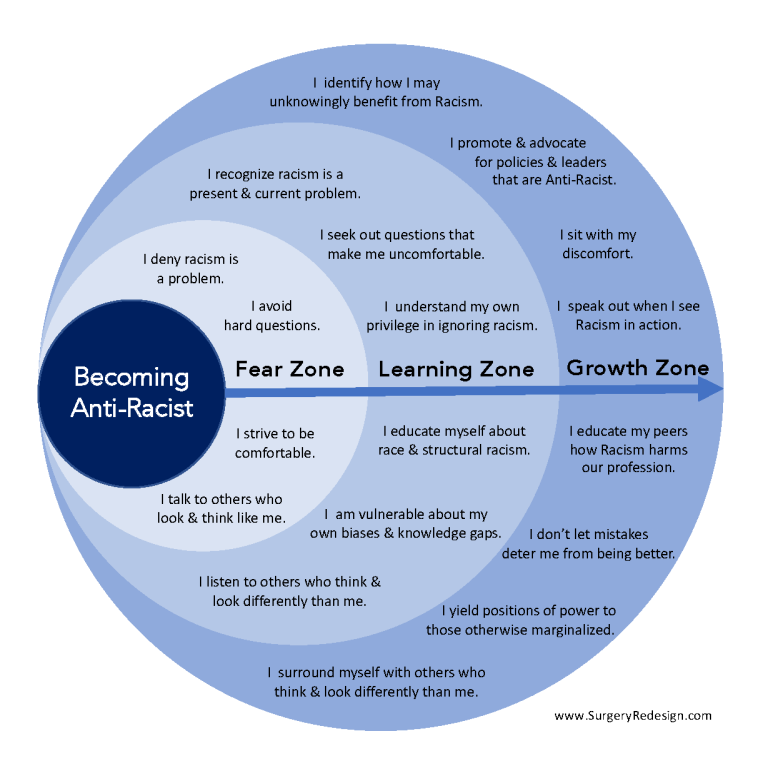
Figure: Becoming an Anti-Racist (Source: John T. Milliken Department of Medicine)
You can develop your understanding of Anti-racist Pedagogy by engaging with our related workshop, which contains much more detail, and is available asynchronously, or live. Find out more on the Cardiff LTA CPD page.
Working with Disabled Students
The UK Equality Act (2010) is the legal framework for our work with disabled people. It provides a definition of disability:
You are disabled if you have: a physical or mental impairment that has a ‘substantial’ and ‘long-term’ negative effect on your ability to do normal daily activities. ‘Substantial’ is more than minor or trivial; ‘long-term’ means 12 months or more.
The Equality Act 2010 applies to all sectors of education, including Higher Education, and defines our responsibilities to provide accessible, anticipatory education for all.
In Cardiff University, the number of disabled students has risen over the last 5 years. Cardiff University Staff can find out more on data and practice for Disability and Reasonable adjustments in our workshop here.
How we conceive of disability will impact how we design and deliver our teaching, and how we respond to disabled students in Cardiff University. The Medical Model of disability is prevalent in the UK, and conceives of disability as intrinsic to the individual, caused by physical, sensory or medical impairment, and a ‘condition’ in need of treatment. The Social Model of Disability challenges these medicalised assumptions, and suggests that disability is separate to a condition or impairment, being defined as the disadvantage or restriction of activity caused by contemporary social organisation, which takes no or little account of people who have impairments and thus excludes them from the mainstream of social activities.
If we apply the social model to higher education, we can appreciate that disability is created by the traditional processes, procedures and practices of learning, teaching and assessment. It is also created by our organisational processes and methods of communication. These create barriers to learning and attainment for our disabled students. For example, a requirement for a diagnosis or assessment prior to an adjustment to teaching practice or assessment would be an illustration of the medical model, whereas flexible, inclusive or universally-designed learning would be an example of the social model.
Where it might put disabled students at a substantial disadvantage, we have a legal duty under the Equality Act (2010) to make reasonable adjustments for existing students, applicants, and former students. The duty is anticipatory and continuing, regardless of whether you know that a particular student is disabled or whether you currently have any disabled students. You should not wait until an individual disabled student approaches you before you consider how to meet the duty (EHRC 2014). You can read more about the policy and your obligations for Reasonable adjustments, with detailed guidance, on the intranet page for Reasonable adjustments.
Inclusive education requires a continuum of support that reaches from the classroom to individual personal assistants from support services, and which incorporates the provision of reasonable adjustments. We need to consider firstly the bottom layer, our universal design of teaching, and then our signposting and interaction with the higher levels.
Figure: UDL and the Continuum of Supports (AHEAD 2023)
You can develop your understanding of Disability and Reasonable Adjustments further by engaging with our related workshop, which contains much more detail, and is available asynchronously, or live. Find out more on the Cardiff LTA CPD page.
Activities for Reflection on Disability (Expand to read more)
Try the exercises below, and reflect:
- What were the challenges?
- How was your concentration?
- How would this translate if note taking in a lecture hall?
Non-Dominant Hand
Write a 100-word paragraph explaining your teaching experience using your non-dominant hand
Cognitive Processing
Copy this sentence out, backwards. Try to check your backwards writing for mistakes.
Dyslexia Exercise
Read the 'Dyslexia Exercise: Backwards Writing' passage below, and reflect on:
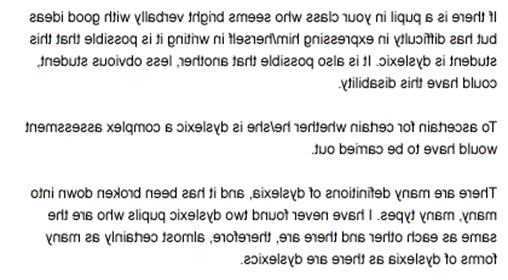
- The skills you used to decode it.
- The frequency and types of error you made in reading it.
- How much of the content you understood in the first reading.
- If you found the reading of this paragraph tiring or a strain.
Disability and Digital Accessibility
The University is legally required to meet accessibility standards on its websites, intranets, and mobile apps. The Equality Act (2010) places a legal responsibility on us all to not only make reasonable adjustments for individuals but also proactively design our digital environments to be accessible. Recent regulations, such as The Public Sector Bodies Accessibility Requirements (2020), reinforce this legal obligation.
You can develop your understanding of Digital Accessibility by engaging with our related workshop, which contains much more detail, and is available asynchronously, or live. Find out more on the Cardiff LTA CPD page.
Working with International Students
The changing demographic of our student population over the last 30 years has been driven by political, economic, educational, social, and technological advances. Our student and staff population offers a rich and diverse global context that enriches and brings value to our universities (Hockings 2010).
Induction and transition
Universities offer a wide range of induction processes for international students with a focus on transitioning them successfully into the new educational culture. However, when discussing transition, we do not just mean the first few weeks of university but how students navigate the student journey and transitions in, through, and out of university.
The process of transition in the broadest sense is complex and includes a huge range of stakeholders and intersectional identities. Many students find the transition process challenging (Kift et al, 2010), and research suggests that for international students the process is even harder to navigate (Wu & Hammond 2011).
International students with English as an additional language can find this transition particularly challenging. Many nuanced factors contribute to how a student acquires language, and it would be unrealistic to expect international students to arrive in the UK using fluent English, and with a knowledge of contextual references, metaphors, and idioms (Echochard and Fotheringham 2017).

Figure: Bell’s (2016) dimensions of international transition support (from Echochard and Fotheringham 2017)
The deficit or value narratives
The deficit narrative is rooted in stereotypes of international students. It is the ‘lack of’ narrative that can foster the presence of intercultural tensions between home students and create the feeling of ‘other’ shaping both learning relationships and pedagogical practices. (Straker 2015). Many international students perceive discriminatory language and bias from their classmates (Heloitt et al 2020), some of which imply that international students need to assimilate into traditional UK pedagogical practices.
Instead, Lomer (2017) applies a value narrative that situates international students as offering a window into the world, enhancing higher education quality by facilitating internationalisation. International students offer a different perspective and, when valued, can enhance the learning experience for all students, gaining cultural competencies that will prepare all for the globalised world.
You can develop your understanding of working with International Students by engaging with our related workshop, which contains much more detail, and is available asynchronously, or live. Find out more on the Cardiff LTA CPD page.
Where next?
Link to other toolkit pages
You can read more about supporting students to ‘Develop Inclusive Mindsets’ on the next inclusivity page. Our three key areas of focus, of Inclusive Design, Teaching Approaches, and Assessment and Feedback are embedded within the main pages. You can also read about inclusivity as applied to Evaluation, Engagement and Collaboration.
To learn more you can also access the other sections of the inclusivity theme: Fostering a Sense of Belonging, and Developing Inclusive Mindsets.
Additional resources and references
CAST 2024. Universal Design for Learning Guidelines version 3.0. Online. Available at: http://udlguidelines.cast.org
Ecochard, Sidonie & Fotheringham, Julia. (2017). International Students’ Unique Challenges – Why Understanding International Transitions to Higher Education Matters. Journal of Perspectives in Applied Academic Practice. 5. 10.14297/jpaap.v5i2.261.
Héliot, Y., Mittelmeier, J. and Rienties, B. (2020). Developing learning relationships in intercultural and multi-disciplinary environments: a mixed method investigation of management students’ experiences. Studies in Higher Education, 45: 11
Hockings, C. 2010. Inclusive Learning and Teaching in Higher Education: A Synthesis of Research. York: Higher Education Academy.
Kift, Sally, Karen Nelson and John A. Clarke. 2010. Transition pedagogy: A third generation approach to FYE – A case study of policy and practice for the higher education sector. The International Journal of The First Year in Higher Education 1: 1-20.
Lomer, S. (2017). Recruiting International Students in Higher Education Representations and Rationales in British Policy. Basingstoke: Palgrave Macmillan
Straker, J. (2015) International student participation in Higher Education: Changing the focus from “International Students” to “Participation”. Journal of Studies in International Education, 20(4), 299-318.
UDL on Campus. 2022. About Universal Design for Learning. Online. Available at: http://udloncampus.cast.org/page/udl_about
Wu, W., & Hammond, M. 2011. Challenges of university adjustment in the UK: A study of East Asian Master’s degree students. Journal of Further and Higher Education, 35(3), pp. 423–438.
International Student Signpost: Academic English Skills for International Students
English Language Programmes’ Academic English Skills team provide free classes and one-to-one tutorials to current international students whose first language is not English. We can support you with advice on the skills you need for academic study in the UK.
Page Authored by: Cardiff University Learning and Teaching Academy: Dr Ceri Morris and Rachel Johns