Module and Session Design
This page introduces you to the core principles and activities when designing for modules, and for individual sessions. It follows on from the previous Programme Scoping and Programme Design pages.
The first module design section is for those who act as a module lead, or for those who wish to understand the process of designing a suite of related individual sessions; for example, for Libraries, Student Futures or Student Support. The second Session Design section is for anyone who wishes to learn more about a structured process to designing sessions that are engaging, inclusive and effective.
Aligned to PSF: V1, V2, A1
You can develop your understanding of Module Design by engaging with our related workshop, ‘‘Designing your Module for Effective, Inclusive Learning and Teaching. Session design is covered in our workshop Designing for Engaging and Active Learning. Find out more on the Cardiff LTA CPD page.
Module Design

Designing a module is both a privilege and a responsibility; and an art and a craft. It involves a range of skills and knowledge of the learning process, awareness of the implications and challenges of assessment and feedback, and the design of inclusive, creative teaching approaches that engage, inspire and support your learners to develop and achieve.
The core concept of any design process is that the planned module learning outcomes, the assessment and feedback strategies, and the teaching approaches used in individual sessions are constructively aligned: that is, that teaching, approaches, learning activities, and assessment must all be deliberately aligned to the intended learning outcomes (Biggs, Tang and Kennedy 2022). In practice, this means that module learning outcomes, content, and assessment tasks are developed concurrently, with each element reinforcing the others.
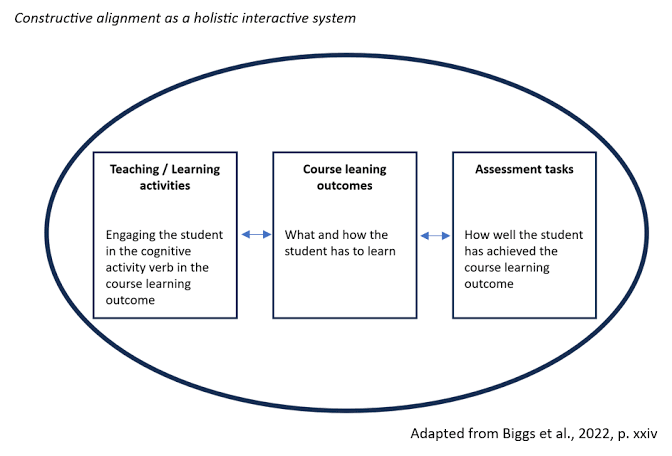
Figure: Constructive Alignment as a Holistic Interactive System. (Adapted from Biggs, Tang and Kennedy 2022: 97)
Linking Learning Outcomes and Assessment: Constructive Alignment
Learning outcomes (LOs) determine what learners need to do, to demonstrate their learning. As such we use ‘backwards design’ (Wiggins & McTighe, 2005): identifying the end goal, and then designing the module to support our learners to achieve that goal.
Designing Module Learning Outcomes (expand to learn more)
LOs are normally made up of three elements:
- A verb to define the specific action that learners to demonstrate their learning.
- A subject, to specify the subject material you want the learning to cover.
- The context of the learning. This reflects the standard required to pass the module as reflected in your assessment and/or marking criteria.
Let’s see that in practical terms:
- An action that can be verified empirically, by ‘the evidence of your eyes and ears’;
- A subject: the given;
- Performance criteria which contextualises the learning (may be implicit).
Examples:
- Outline the structure, functions and physiological processes of human tissues and organs where relevant to patient care. (Level 4 module)
- Recognise the effects of anxiety on pain perception and on the individual’s ability to cope with dental interventions. (Level 5 module)
- Effectively communicate complex information and arguments to diverse audiences, either individually or collaboratively as part of a team. (Level 6 module)
- Demonstrate a systematic and critical understanding of how findings from studies of associative learning in animals can be explained by currently influential theories of associative learning. (Level 7 module)
Module learning outcomes should always be assessable, so their wording needs to reflect the skills and behaviours students should be able to demonstrate on successful completion of the module: we cannot know if learners ‘understand’ a concept, so LOs describe what learners will do, to demonstrate that they understand.
They should also be inclusive, so should not identify any action that cannot be subject to a reasonable adjustment, which might exclude learners under the Equality Act, such as disabled learners, apart from those that are a competence standard for the programme. For example, you would only use ‘Present complex information verbally…’ if this is a core competence: otherwise you might use ‘Communicate…’ and enable an alternative assessment as a reasonable adjustment, such as a written piece. You can find out more in our CPD workshop, ‘Disability and Reasonable Adjustments’.
Module learning outcomes reflect the actions students must complete to pass the module: the level of success in achieving the outcome, outlined in the marking criteria, determines the grade. You can find more detail on assessment design and marking criteria on our assessment for learning pages.
This accessible short recording explains constructive alignment:
A module represents ‘A self-contained, formally structured unit of study, with a coherent and explicit set of learning outcomes and assessment criteria’. (QAA, 2022). However, each module is just one element of a programme. All modules should combine to ensure that across a programme, students are able to achieve the programme learning outcomes (for more information, visit the Programme Development page). Through a series of modular assessment tasks, students should have demonstrated achievement of the programme outcomes.
Module Lead responsibility for making changes
You may be building a module from the beginning, as part of the programme development process, working with the broader programme team. However, you may have ‘inherited’ an existing module. Any module design should be part of the broader considerations of the overall programme. Work with the Programme Lead when developing or changing modules, to ensure the changes fit with the overall approaches, the assessment design, and importantly, the student experience of the programme as a whole. Cardiff University staff can read much more on Programme Development on the ‘Approving and Managing Programmes’ intranet pages.
If you have inherited a module, be aware that you cannot make any changes to the fundamental features of the module, as these will have been subject to Quality Assurance (QA) processes, and, as they are published on the external Course Finder page, form part of the legal contract of the offer to students. These include the programme and module learning outcomes, and the nature of the assessments.
The components of a module, that appear in the ‘Module Description’ and published on the Course Finder internet page, can only be changed by following the ‘Procedure for the approval of programmes, modules, and other credit bearing provision’. At a minimum, this means approval by the appropriate Board of Studies, or for changes to learning outcomes or assessments that are considered fundamental to the structure and integrity of the programme, need to be considered by the College Education Dean, and subject to a ‘major changes’ QA process.
Designing your module or suite of sessions
To ensure your module design addresses all of the necessary components, a comprehensive planning tool, such as a Scheme of Work, can help. This can aid you to check you will address the core themes: that it is effective and inclusive, that it addresses Education for Sustainable development, and that it embeds core Skills for Success. It can also ensure that it is constructively aligned, engaging and effective, and transparent for all students and staff involved.
A module plan, or Scheme of Work, is not a bureaucratic document but a ‘tool for thinking with’. It can be developed in collaboration with relevant staff, such as the Programme Lead, teaching staff and guest lecturers and students. It ensures consistency in teaching practice, and a simplified version can aid transparency and support for learning for students. It can also act as a fallback in the event of module lead absence or change, and as a review and reflection tool at the end of the module. It can also inform overall programme planning by making details transparent for Programme Leads and other Module Leads on the programme.
Components of a Scheme of Work (expand to read more)
There are many Scheme of Work templates available, and you may wish to adapt the following template to suit your purposes, but the sections in the template enable a thorough consideration of the key components and flow of the module, and springboard the design of individual sessions (see Section 2, below). Therefore, you might find the outline below helpful, as a starting point. You can download a blank Scheme of Work here, or read an exemplar Scheme of Work using the template here.
| Module title and code:
Level: Name and code: |
Duration: | Programmes taking the module: |
| Aim: | Module Learning Outcomes: By the end of the module, learners will be able to:
· Relationships to Programme Learning Outcomes: Meets PLOs: · |
Cohort Details: |
| Notes for inclusive practice and diversity:
|
Assessment(s):
Formative: Summative 1: Summative 2:
|
| Module title and code:
Level: Name and code: |
Duration: | Programmes taking the module: |
| Aim: | Module Learning Outcomes: By the end of the module, learners will be able to:
· Relationships to Programme Learning Outcomes: Meets PLOs: · |
Cohort Details: |
| Notes for inclusive practice and diversity:
|
Assessment(s):
Formative: Summative 1: Summative 2:
|
| Week | Session Focus/Title | Session Learning Outcomes
|
Teaching approach and Content of Session
|
Learner activities | Assessment: Related formative / summative tasks
|
Evaluation |
| 1 | Introduction to the content and the module | · | · |
|
|
|
| 2 | Content 1
|
· | · | |||
| 3 | Content 2
|
· | · | |||
| 4 | Content 3:
|
· | · | Formative submission
|
Mid-module evaluation | |
| And so on… | · | · |
Learning Design: Designing Inclusive and Structured Module Timings, Plans, and Materials
Designing structured, inclusive, and active learning experiences ensures that every student, regardless of background or study mode, can access learning materials, manage their study time, and participate meaningfully. By aligning module timings, crafting flexible, student-centred lesson plans, and selecting accessible resources, you reduce learning barriers and foster an engaging, equitable learning environment.
Practical tips
- Structure Module Timings & Workload: Be realistic about student study time. Clearly signpost expected time allocations for pre-session, in-person, and independent learning activities to help students manage their workload.
- Apply Universal Design for Learning (UDL): Offer learning materials in multiple, accessible formats (e.g., captioned videos, screen-reader-friendly PDFs, digestible reading lengths) to support diverse learning preferences and needs.
- Build Active & Inclusive Lesson Plans: Integrate varied interactive activities (such as think-pair-share, digital polling, or small group discussions) into sessions to keep engagement high and give all students a voice.
- Provide Materials Early: Share essential pre-reading, slides, and session materials in advance to give neurodivergent students, non-native English speakers, and those with busy schedules time to prepare.
- Scaffold Content & Signpost Connections: Group learning materials logically by week or topic on Learning Central, ensuring each resource explicitly links to a session activity or learning outcome.
- Audit for Accessibility & Diversity: Ensure reading lists and case studies reflect diverse perspectives and voices and use accessibility checkers for all uploaded digital content.
Inclusive Learning Design Principles
Inclusive Learning Design Principles
Inclusive design goes beyond basic compliance; it creates flexible, supportive learning environments where all students can thrive.
- Inclusive Lesson Planning: Active learning strategies move the focus from content transmission to active student engagement. Designing inclusive plans involves building in buffer time for processing, offering low-stakes opportunities for participation, and varying group dynamics (individual reflection, paired tasks, full-group syntheses).
- Manageable Module Timings: Student cognitive overload often stems from unclear expectations around independent study hours. Transparent timing models explicitly break down weekly expectations (e.g., 2 hours pre-reading, 2 hours active workshop, 1-hour post-session reflection), helping students balance study with external commitments.
- Accessible Learning Materials: Constructing accessible learning materials using Universal Design for Learning (UDL) frameworks reduces the need for reactive adjustments. Providing accessible headings, alternative text for images, structured document formats, and open-source or digital-first readings ensures seamless access across all devices and learning needs.
Session Design
Session design follows many of the same principles and processes as module design, above. The core concept is, again, constructive alignment (Biggs, Tang and Kennedy 2022): that the session learning outcomes (LOs), the assessment and feedback strategies, and the teaching approaches are purposefully designed and aligned to support learners.
If the session is part of a suite of sessions, these should also pay attention to the overall structure and module planning. Each session should use inclusivity principles, embed Sustainability and Skills for Success, and be transparent to learners. Planning should also ensure you consider the specific identities and needs of your learners, and plan for diversity and contingencies such as ‘stretch and challenge’ activities for advanced learners.
Each session should include: an introduction or hook, with links to prior or existing knowledge, and summary of the session and LOs, to engage learners; a main section incorporating a range of learner activities to enable them to engage, apply and construct their own learning, and a plenary or other form of conclusion to summarise the session, explain links to future sessions, and/or an activity to check learners have met the learning outcomes. Timings are crucial, and often learned through experience: failure to complete planned activities can result in gaps in knowledge or skill development, and student frustration. Using ‘chunking’ of learning through careful timing avoids cognitive overload and also supports student learning.
Designing your Session
Begin by establishing your learning outcomes and formative assessment of achievement of the learning outcomes. This is in many ways the most creative part of the process: ‘what do I want them to do to demonstrate they have learned what I intend?’. This form of formative assessment is informal, and small scale: for example: ‘Learners will identify three challenges of lesson planning, and feedback orally, as a group’.
Next, identify the teaching approaches you will use to enable learners to meet this outcome. As the box above illustrates, a variety of teaching approaches should be used, using the principles of Universal Design for Learning, to ensure that one group of learners is not disadvantaged consistently over another. You might use the ABC method for session design, or select approaches which most suit the topic, task or cohort. You can discover more about the range of innovative and research-informed active learning approaches on the Teaching Approaches page.
As for a module Scheme of Work (above), a Session Plan can help. It can aid you to check you will address the core themes of inclusivity, sustainability and employability, and that the session is constructively aligned, engaging and effective, and transparent for all students and staff involved. It is therefore ‘a tool to think with’: a prompt for you as you prepare, or a guide to pass on as a contingency in case of absence.
It can also be shared with the module lead or others involved in broader planning and design processes, and can aid planning for both formative assessment within the session, or its contribution to preparation for summative assessment. A simplified version shared online or discussed at the beginning of the session can help learners make links to previous learning, anticipate session activities, and understand the link between the individual session and the overall requirements of the module.
Components of a Session Plan (expand to learn more)
There are many session plan templates available, and you may wish to adapt the following template to suit your purposes, but the sections in the template below and in this blank session plan enable a thorough consideration of the key components and flow of the session. You can read an exemplar session plan using the template here.
Title:
Duration:
Module/Series and Cohort:
Aim:
Learning Outcomes (LOs): By the end of the workshop, learners will be able to:
Notes for inclusive practice and diversity:
Link to assessment
Location:
Duration/Time
Teaching strategy and content (Task)
Resources
Learner Activity
Tutor Notes
Assessment
Introduction: Hook, session plan and LOs
Conclusion/plenary
In the recording below, Ada explains session design using a session plan :
Components of a Session Plan (expand to learn more)
There are many session plan templates available, and you may wish to adapt the following template to suit your purposes, but the sections in the template below and in this blank session plan enable a thorough consideration of the key components and flow of the session. You can read an exemplar session plan using the template here.
| Title: | Duration:
|
Module/Series and Cohort:
|
| Aim:
|
Learning Outcomes (LOs): By the end of the workshop, learners will be able to:
|
|
| Notes for inclusive practice and diversity:
|
Link to assessment | Location: |
| Duration/Time | Teaching strategy and content (Task) | Resources | Learner Activity | Tutor Notes | Assessment |
|
|
Introduction: Hook, session plan and LOs | ||||
|
|
|
||||
|
|
|
||||
| Conclusion/plenary |
|
|
See here for our tips on planning large lectures.
Where Next?
Link to other toolkit pages
This page relates closely to the guidance on our Inclusive Design page. There is also much further detail on the design of assessments (both formative and summative) on our Assessment pages.
Additional resources and references
Biggs, J.B., Tang, C.S., Kennedy, G. and EBSCOhost. 2022. Teaching for quality learning at university. Fifth edition / John Biggs, Catherine Tang, Gregor Kennedy. Maidenhead: Open University Press. Available at: https://search.ebscohost.com/login.aspx?direct=true&scope=site&db=nlebk&db=nlabk&AN=3417540
Wiggins, G and McTighe, J. 2005 Understanding by Design. Alexandra, Virginia: ASCD
Page Authored by: Cardiff University Learning and Teaching Academy: Dr Ceri Morris