Fostering a Sense of Belonging for All Students
Belonging is the sense of being valued and accepted within a community. On this page you will read about how you can support belonging and community in Higher Education, by enabling students to see themselves in the curriculum, through effective transition support, and by challenging the hidden curriculum. It is for anyone who is teaching or supporting students, in any role.
PSF Alignment: V1, V2 K1,K2, K3
The Inclusive Education Enhancement model has a number of areas of focus for fostering a sense of belonging and diversity, to further support your self-reflection and development. You can learn more in our Embedding Inclusive Education in your Practice: Designing, delivering and assessing learning for all workshop. Find out more on our LTA CPD page.

Understanding Belonging
Watch Carin Taylor’s (24 March 2022) TEDxSonomaCounty talk ‘Belonging, A Critical Piece of Diversity, Equity and Inclusion’’:
Research shows that students with a strong sense of belonging in higher education are more motivated, persistent, and academically successful (Meehan & Howells, 2017; Gillen-O’Neel, 2019). Representation and understanding increase student engagement and satisfaction (Good et al., 2012), and recognising how diverse characteristics (such as social class, ethnicity, disability, gender identity) intersect helps us support underrepresented students more effectively (Haddow & Brodie, 2023).
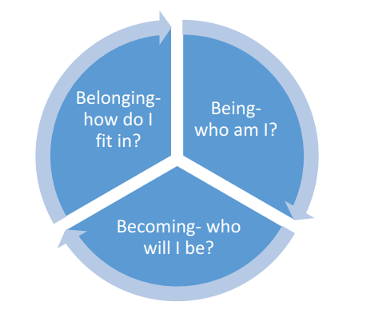
Conceptual Frame of Being, Becoming and Belonging.
Read more in this short blog on Building Student Belonging by Dr Helen Webster or listen to this podcast on Belonging from the ‘Talking Learning and Teaching’ Spotify page.
Recognising and celebrating the diverse university community and enabling students to see themselves represented in the curriculum
Creating an inclusive environment means actively recognising and celebrating the diversity within our community. Representation in the curriculum allows students to see themselves valued in the academic setting. By embracing and representing varied backgrounds, perspectives, and experiences, for example in images, case studies or discussions, students can bring their whole selves to their learning, enhancing their engagement and sense of belonging (Thomas, 2012).
Belonging: the relationship between Equality, Diversity and Inclusion, Freedom of Speech and Academic Freedom (Expand to read more)
Higher education institutions (HEIs) have a significant role to play in promoting equality, diversity and inclusion within their institutions, and in championing freedom of speech and academic freedom. In doing so, HEIs strive to foster mutual respect, understanding, and tolerance to create an environment that encourages the free exchange of lawful ideas and perspectives, while also promoting inclusion and belonging for all staff and students.
Advance HE has recently published this document: Embedding Freedom of Speech and Academic Freedom in Equality, Diversity and Inclusion | Advance HE regarding Higher Education’s responsibilities and commitment to freedom of speech and inclusion.
HEIs, like all public authorities, are required by the Equality Act’s Public Sector Equality Duty to give due regard to the need to foster ‘good relations’ between protected groups. While the term has fallen out of use somewhat, it is a useful concept to return to, in a period of so-called ‘culture wars’.
Special legal status applies to the promotion and protection of free speech and enquiry within HE. This means institutions need to support scholarship and learning that engages with a wide range of political, social, religious, economic and scientific views, regardless of how unpopular, controversial or provocative these views may be. Alongside this, institutions have a legal duty to ensure that staff, students and others who engage with the institution are protected from unlawful discrimination, harassment and victimisation, and that good relations between individuals and groups are facilitated without restricting lawful free speech. (Advance HE 2024: https://advance-he.ac.uk/knowledge-hub/promoting-good-relations-higher-education-guidance)
Student transitions
Supporting diverse students in their transition to higher education is essential, especially as more non-traditional students are joining our community. Successfully managing these transitions requires a coherent approach that recognises our student population’s diversity. Transition is an ongoing process throughout the student life cycle (Thomas, 2012).
The University has made a SharePoint site for transition resources. This new site contains guidance and resources, especially for teaching undergraduate students in the first semester.
Transition is more than just the first 2 weeks, it is an ongoing process; in, through, and out of the university:
- In: Supported by: Induction activities, creating a sense of belonging, and exploring and co-creating academic customs, expectations and practices
- Through: Supported by: Academic development and support, alongside pastoral support and personal development opportunities
- Out: Supported by: Personal and academic development opportunities and career planning
Practical Strategies for supporting student transitions:
Pre-arrival engagement.
- Personalised welcome communications: Use welcome emails, videos, and social media to introduce students to Cardiff’s community
- Inclusive induction activities: Design induction events that facilitate social connections and clarify academic expectations, addressing unspoken norms early. Early collaborative assignments or small-group projects in the induction week encourage social integration and lay the groundwork for future group learning
- Peer-led social events allow new students to connect with experienced peers who can share insights.
- Interactive workshops on university culture: Sessions that demystify academic standards, unspoken norms, and assessment expectations can ease academic transition.
Ongoing support:
- Regular check-ins by academic advisors: Scheduled check-ins throughout the academic year provide students with consistent support.
- Peer mentorship programmes: Assigning mentors from similar backgrounds or disciplines creates a support network.
- Community-building events across the year: Offering social and academic events beyond induction, such as guest lectures, themed discussions, or socials
Preparation for graduation and beyond:
- Signpost to careers advice and Student Futures
- Check awareness of graduate attributes and ways of articulating their skills, in relation to the degree, in CVs and interviews
The Hidden Curriculum
For some students, aspects of institutional practices and processes, and even language, inhibit the development of a sense of belonging. The hidden curriculum refers to the unspoken norms, values, behaviours, and expectations within academia.
Making these explicit is essential for creating a supportive environment, particularly for first-generation students and other under-represented groups. There are significant challenges of the hidden curriculum, as it is seen to be the processes of social and cultural reproduction that serve to ensure the ‘preservation of existing social privilege, interests, and knowledge of one element of the population at the expense of less powerful groups’ (Hinchcliffe 2021: 30).
The hidden curriculum impacts at the intersection between student life experiences and university education, as illustrated in Figure 1, below.
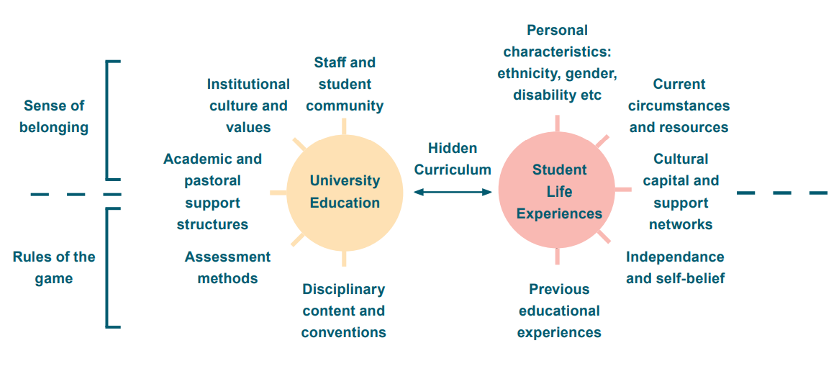
Figure: The Hidden Curriculum in Higher Education (Hinchcliffe 2021: 74)
Reducing the impact of the hidden curriculum can be done from either a deficit model or an inclusive standpoint. In the deficit model it is the responsibility of the student to adjust to the norms of the university. A more inclusive approach requires the university and its staff to adjust to accommodate the experiences and needs of the diverse student body, and to clearly articulate expectations where necessary, making the hidden curriculum transparent to all students.
Practical strategies for addressing the hidden curriculum
Transparency in expectations (expand to read more)
Inclusive communication
Reflective Activity:
What aspects of teaching practice in your schools have unstated rules, expectations and norms of behaviour, or rely on uncontested, taken-for-granted knowledge or experiences?
Think about lectures, seminars, labs or practicals, induction sessions, independent study.
Where next?
Link to other toolkit pages
To learn more you can access the next two sections of the inclusivity theme: Empowering Students to Fulfil their Potential, and Developing Inclusive Mindsets. You can read more about compassionate communication and empathetic and compassionate pedagogy in the Teaching Approaches section.
You can also read about inclusivity as applied to your practice in each section: Design; Teaching Approaches; Assessment and Feedback; and Collaboration.
Additional resources and references
Gillen-O’Neel, C., 2019. Sense of belonging and its link to students’ academic motivation, engagement, and achievement. Educational Psychology, 34(4), pp. 410-425.
Good, J., et al., 2012. Fostering belonging in higher education. Journal of Higher Education, 83(3), pp. 240-272.
Haddow, M., & Brodie, P., 2023. Intersectionality in education: Belonging and the student experience. Journal of Social Issues in Education, 5(1), pp. 100-115.
Meehan, C., & Howells, K., 2017. The importance of belonging for student engagement. Student Success, 8(2), pp. 111-119.
Thomas, L., 2012. Building student engagement and belonging in Higher Education at a time of change. London: Paul Hamlyn Foundation.
Read more about Belonging and Student retention and attainment in this article from Advance HE
Page Authored by: Cardiff University Learning and Teaching Academy: Dr Ceri Morris