Programme Level Design of Assessment
This page provides practical tools and considerations to support Schools and programme teams in taking a holistic, programme- level approach to assessment design. Together, these resources aim to support programme teams to design assessments that map clearly to programme learning outcomes, avoid over-reliance on particular assessment types, and scaffold students’ development throughout their studies. This approach promotes a structured, balanced, and academically robust assessment strategy that enhances learning and aligns with inclusive education principles and university strategy. In addition, it encourages programme teams to proactively consider the role of Generative AI in assessment design, ensuring tasks remain authentic, transparent in expectations, and aligned with the responsible use of emerging technologies in GenAI. Finally it supports staff to take a robust approach to developing assessment criteria
It is intended for all staff involved in Programme Development, whether academic or professional services, and whether the development under consideration is a new programme or enhancements to existing programmes and/or modules. Staff may be working at an Fellow or Senior Fellow level.
Aligned to PSF: V1, V2, K1, K3, K5, A3
You can develop your understanding of Inclusive Education by engaging with our related workshops, ‘Embedding Inclusive Education in your Practice‘, ‘Effective and Inclusive Programme Design‘ Generative AI: Taking the Two Lane Approach. Find out more on the Cardiff LTA CPD page.
Programme Level Approach to Assessment Design
Key Principles of Programme-level Design
Cardiff University’s Inclusive Education Framework highlights the commitment to supporting all students to achieve their potential through inclusive learning, teaching, and assessment practices. A key part of this commitment is ensuring assessments are designed in ways that are accessible, coherent, and aligned to what students need to learn and demonstrate.
The University does not prescribe how assessments should be designed or managed within individual programmes; these decisions are rightly academic matters, influenced by factors such as the programme learning outcomes, curriculum structure, resource considerations, student needs, and any specific requirements set out by professional and/or regulatory bodies.
However, the University does have a responsibility to support Schools in designing assessments that reflect the principles of the Strategic Approach to the Enhancement of Assessment and Feedback – 2023-2027. Adopting a strategic approach enables both staff and students to use their time more effectively, enhances consistency, and safeguards academic standards.
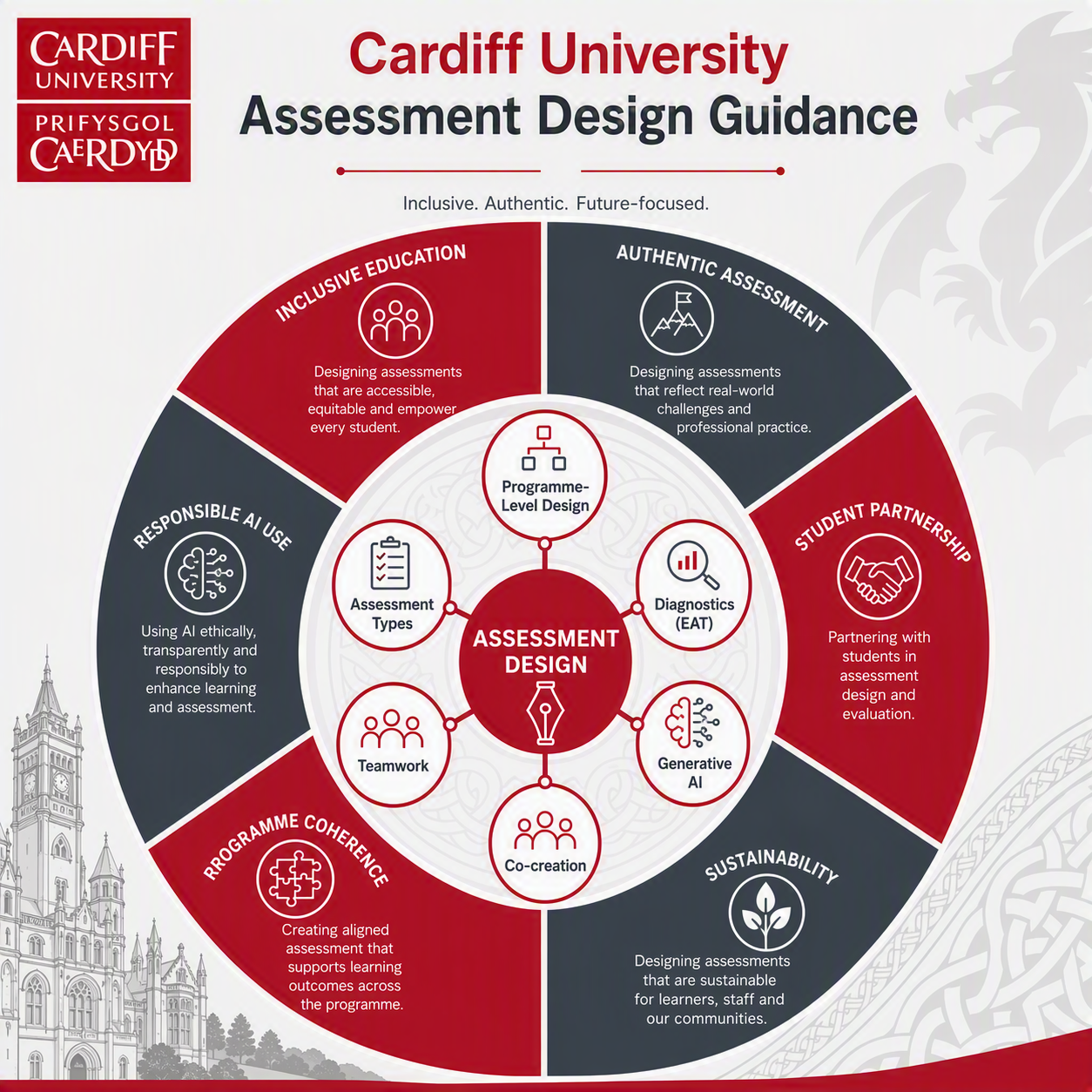
Cardiff University’s Inclusive Education Framework highlights the commitment to supporting all students to achieve their potential through inclusive learning, teaching, and assessment practices. A key part of this commitment is ensuring assessments are designed in ways that are accessible, coherent, and aligned to what students need to learn and demonstrate.
The University does not prescribe how assessments should be designed or managed within individual programmes; these decisions are rightly academic matters, influenced by factors such as the programme learning outcomes, curriculum structure, resource considerations, student needs, and any specific requirements set out by professional and/or regulatory bodies.
However, the University does have a responsibility to support Schools in designing assessments that reflect the principles of the Strategic Approach to the Enhancement of Assessment and Feedback – 2023-2027. Adopting a strategic approach enables both staff and students to use their time more effectively, enhances consistency, and safeguards academic standards.
A programme‑level approach to assessment design involves planning, implementing, and managing assessment and feedback across an entire programme rather than within individual modules (Jessop et al., 2013). By designing programmes in this holistic way, assessments and feedback can be deliberately sequenced to build students’ skills progressively and to ensure that all assessment activity clearly supports students’ achievement of the programme’s learning outcomes.
It is recommended that all taught programmes consciously adopt a programme-level approach to assessment design. Using a more holistic approach to assessment design will ensure an appropriate range and levels of assessments are offered within and across modules/a degree programme.
Balancing assessment across programmes
Adopting a programme level approach requires programme teams, as an initial exercise, to consider several fundamental questions. It is recommended that programme leads and/or teams review the overall balance of assessment types across the programme, taking into account the relationship between assessment for learning and assessment of learning, as well as the validity and reliability of the assessments used.
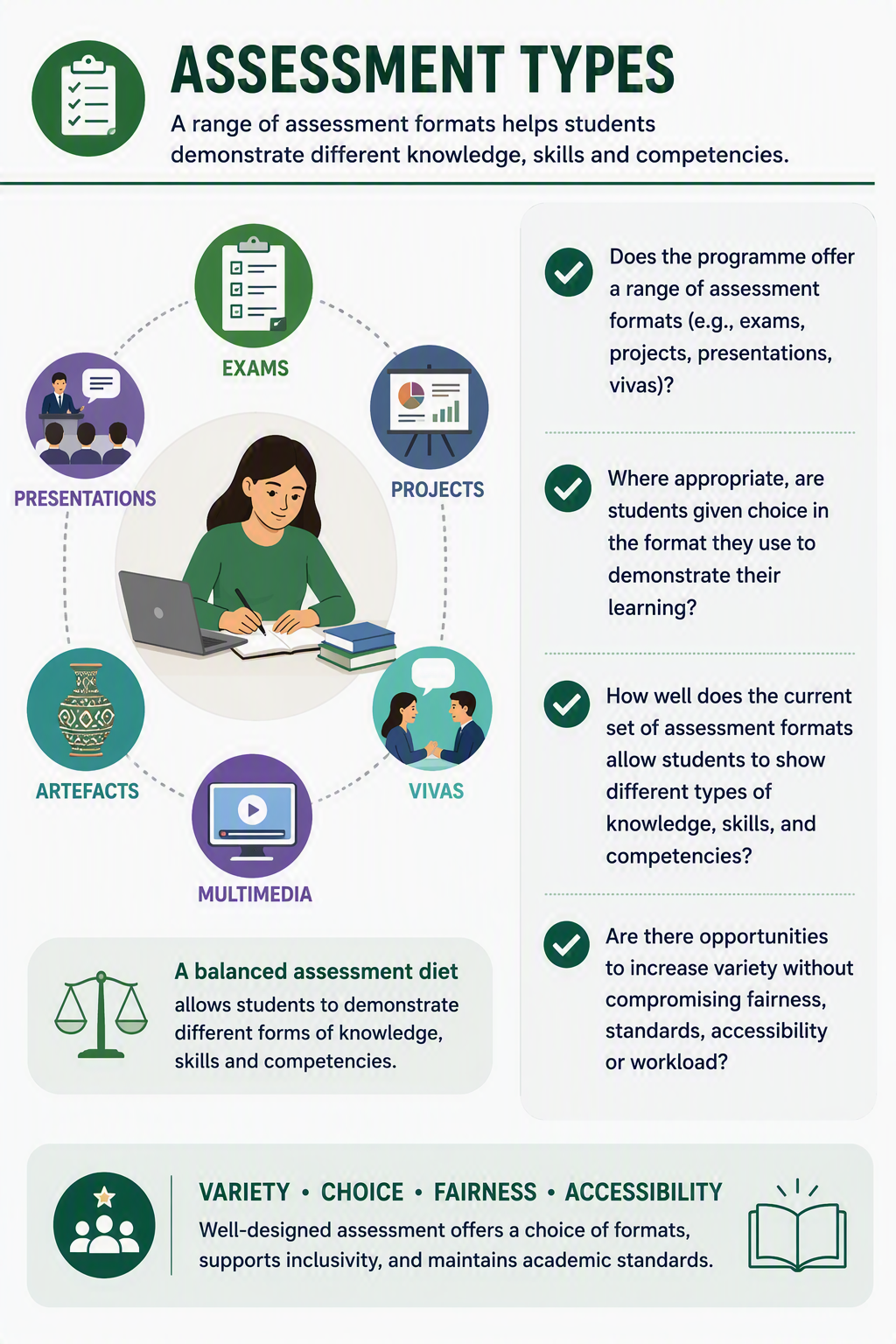
Reflect on the following when considering assessment types:
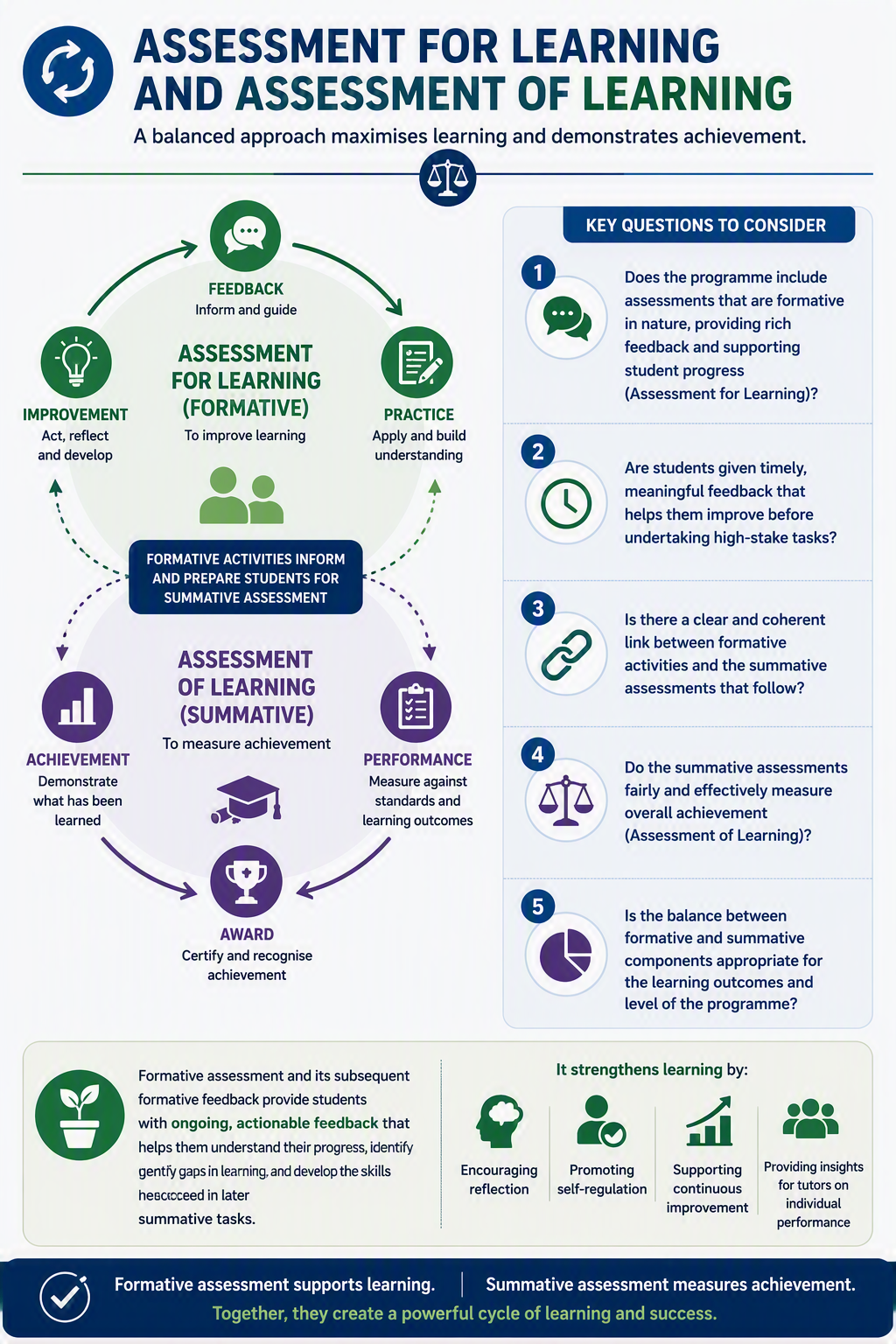
Reflect on the following when considering Assessment for Learning and Assessment of Learning:
Assessment Load
Across programmes, assessment needs to be made more manageable for staff and students, by:
Mapping assessment to Programme Learning Outcomes
Ensuring all assessments align with the programme learning outcomes, safeguarding academic standards and mapping student achievement against the desired competencies and skills. In turn, this can help avoid an approach in which exam preparation is prioritised over broader integrative study.
Managing workloads
Programme teams should seek to distribute assessment tasks evenly across the programme to prevent student and staff overload. Whilst more innovative and authentic tasks can appear to require more staff input, this is not always the case, particularly where partnership working with students occurs. Adopting more flexible approaches to workload allocation that recognise the increased resources needed to manage some of our assessments may need to be further considered.
Managing assessment volume
As well as seeking to reduce the overall number of summative assessments, programme teams should seek to avoid deadline bunching (using the Assessment Visualisation Tool), scaffold formative tasks that feedforward and build assessment and feedback literacy and ensure marking and feedback can be managed without negatively impacting on student and staff wellbeing. Focusing on the quality rather than the quantity of assessments will reduce unnecessary stress and allow for deeper learning and reflection.
Using ‘Capstone’, ‘Cornerstone’ and Cross-Modular Assessments
Cornerstone and capstone modules can play a crucial role in taught programmes by providing structured opportunities for students to integrate and apply their learning. Cornerstone modules, typically offered early in the programme, help students build foundational skills and knowledge, setting the stage for more advanced study. Capstone modules, usually positioned at the end of the programme, allow students to synthesise and demonstrate their cumulative learning through comprehensive projects or research. This approach not only reinforces key concepts but also enhances critical thinking, problem-solving, and real-world application, ultimately preparing students for professional success and lifelong learning.
Schools interested in introducing Cornerstone and/or Capstone modules, or who are interested in exploring and/or piloting cross-module programmatic assessments are advised to seek support from the LTA.
Assessment Types and Assessment Lengths
Whilst exams and other time-limited assessments should be broadly comparable in length / time across a programme, the same equivalencies should not be used for coursework tasks, given the inability to recognise the complexity of different tasks or to take into account the different time it can take to complete different tasks (e.g., writing a 300-word abstract could take longer than a 1,000 word short essay). Word counts may not also be appropriate for all types of assessment, nor recognise cognitive load or alternative submission formats. For more information, please refer to the Institutional expectations.
Top tips: Planning a balanced programme assessment diet
Creating a visual overview of the proposed assessment diet across a programme is an effective starting point for understanding and reviewing all planned assessments. This overview helps identify busy periods, potential deadline clashes, and any overreliance on a particular assessment method so these can be addressed early. It also enables programme teams to judge whether the overall assessment pattern offers an appropriate balance to support the validity and reliability of assessment decisions. In addition, this process can help teams consider how the two‑lane approach might be embedded without compromising our core principle of developing graduates who are independent, critical thinkers.
Diagnostic Tools (Cardiff EAT)
It is recommended that all taught programmes regularly review and evaluate current assessment and feedback provision. By gaining a clear understanding of staff and student perspectives, programme teams can make informed decisions that foster continuous improvement, support innovation, and enhance the validity, reliability, and manageability of assessments.
Without a thorough understanding of the strengths and weaknesses in existing assessments, quickly planned changes are unlikely to enhance the overall quality of the programme, promote fairness, or improve student satisfaction and success. Below are details of Cardiff EAT tool which is used to evaluate existing assessment practices across Programmes.


Figure: Image from: EAT FRAMEWORK | EAT Framework
The Cardiff EAT model is a research-informed integrative assessment framework designed to consider all aspects of assessment practice and the interrelationships between them with colleagues.
The model strives to bring the student voice to the fore, with space to explore assessment literacy among students and to reflect on the student experience of assessment across a programme.
It differs from the original EAT Framework (Evans, 2016) as it is intended to be used at a programme level and is aligned to Cardiff’s Institutional Expectations.
What can Cardiff EAT offer Schools?
Cardiff EAT promotes programme level planning, which enables us to ensure that the student learning experience is one which builds throughout the programme, with assessment methods aligned to learning outcomes and learning activities. Taking a programme level view promotes good assessment practice and can contribute to the development of a consistent and inclusive assessment strategy.
Benefits of reviewing assessment across a programme:
- Prevents over-assessment and avoids assessment ‘bunching’;
- Ensures alignment between programme and module level learning outcomes;
- Offers an opportunity to reflect on the use of Generative AI in assessment design;
- Promotes variety in assessment types;
- Encourages assessments which are accessible to all students and develop a range of skills;
- Allows learning activities to be co-ordinated across a programme;
- Contributes to the development of graduate skills;
- Meet professional or regulatory requirements.
How is Cardiff EAT used?
The Cardiff EAT model can be used, flexibly, in a range of scenarios: As part of assessment design work in Schools; in revalidation work, to inform the development of a revised assessment strategy; and in response to NSS action plans.
Resources include:
- Menti student/staff surveys which can be adapted to use a bespoke question set, based on the Cardiff EAT framework.
- An action plan which consolidates information from drawn from the EAT process to create a clear plan for how changes can be implemented at programme and module level.
Generative AI and Assessment Design
Generative artificial intelligence (GenAI) tools are increasingly shaping how students learn, study and produce university work. Many Cardiff University students are already using these tools, and staff are encountering their impact across teaching, assessment and feedback.
This section provides light‑touch, practical guidance for Cardiff University staff on how GenAI can be approached within learning, teaching and assessment. It is designed to support colleagues in making pedagogically informed decisions, particularly when designing or reviewing assessments.
This guidance complements (but does not replace) institutional policy and intranet guidance, focuses on enhancement rather than enforcement a supports staff across disciplines and levels of experience.
Cardiff University’s Position on GenAI
Cardiff University’s current institutional guidance on artificial intelligence in education is available on the staff intranet and should always be the primary point of reference.
While formal University guidance on generative AI in learning, teaching and assessment continues to evolve, colleagues are encouraged to adopt transparent, proportionate and pedagogically grounded approaches that align with emerging sector practice and Russell Group principles.
Russell Group Principles (expand to read)
Cardiff’s approach aligns with Russell Group principles, which are:
- Universities will support students and staff to become AI-literate.
- Staff should be equipped to support students to use generative AI tools effectively and appropriately in their learning experience.
- Universities will adapt teaching and assessment to incorporate the ethical use of generative AI and support equal access.
- Universities will ensure academic rigour and integrity is upheld.
- Universities will work collaboratively to share best practices as the technology and its application in education evolves.
Framing Gen AI Use: A Two-lane Approach
In the absence of Cardiff‑specific assessment classifications, the University is currently drawing on the University of Sydney’s two‑lane assessment model as a helpful framing device when communicating expectations to students.
In brief:
Lane 1
Secure assurance of learning
- Trustworthy judgements about progress and attainment.
- Integrity of the award and individual learning protected.
- Controlled conditions, contextual task design, or verification.
Lane 2
Open assessment for and as learning
- Open, supported assessment outside controlled settings.
- AI use cannot be prohibited in unsecured contexts.
- Focus on ethical, critical and discipline-specific use.
“
The two-lane model should not be interpreted as permission to ban or permit GenAI universally across a module or programme. Instead, it supports balanced, outcome-led decision-making. Staff should consider which learning outcomes require students to demonstrate knowledge, skills or judgement independently, and where these may need to be assessed in a secure or verifiable context. Equally, where GenAI use is appropriate within open assessment contexts, students should be supported to use it critically, transparently and in ways that align with the intended learning outcomes. The focus should be on what needs to be evidenced, not on applying blanket rules to whole assessments.
Cardiff University Approved Tools
For Cardiff staff and students, Microsoft Copilot, Google Gemini and NotebookLM are institutionally available GenAI tools. University accounts should be used to access these platforms, as they align with Cardiff University’s institutional security standards, handle data appropriately, and are approved for use within Cardiff’s digital tool environment.
GenAI Capabilities and Limitations
GenAI tools are developing rapidly. The points below reflect typical capabilities and limitations at the time of writing and should be interpreted cautiously as tools continue to evolve.
GenAI tools can support learning in many ways, particularly when used to explore, question and develop understanding rather than simply produce finished work. For example, students and staff may use GenAI to:
- Generate ideas, questions or initial outlines;
- Explore unfamiliar topics or receive alternative explanations;
- Summarise, rephrase or compare concepts;
- Test understanding through dialogue, prompts or practice questions;
- Support coding, debugging or problem-solving;
- Draft, redraft or structure arguments;
- Produce examples, scenarios or teaching explanations.
As with any source of information, AI-generated responses should be checked, questioned and contrasted with reliable academic, professional or disciplinary sources. Key limitations and risks are that GenAI tools:
- Produce probabilistic outputs, not verified knowledge;
- May generate confident but incorrect information (“hallucinations”);
- Can fabricate references or misrepresent sources;
- Lack contextual and disciplinary judgement;
- May reinforce bias or exclude marginal perspectives;
- Often produce fluent output that masks surface‑level understanding.
Generative AI tools present significant opportunities for teaching and learning, but also introduce important challenges for assessment. Expand the headings below for guidance which outlines key risks identified in recent research and highlights implications for practice.
Over-reliance may inhibit skill development
Emerging evidence suggests that over-reliance on generative AI tools can reduce students’ engagement in the cognitive processes necessary for learning, including analysis, synthesis, and problem-solving. When AI performs key elements of academic work, students may bypass “productive effort”, limiting the development of disciplinary expertise and independent judgement.
AI-generated output does not reliably evidence student understanding
AI-generated work cannot be assumed to reflect a student’s own knowledge, reasoning, or achievement, undermining the validity of assessment. As a result, the submitted product alone is no longer a reliable indicator of learning.
Uncritical use can undermine academic integrity and disciplinary standards
Uncritical use of generative AI risks undermining academic integrity, authorship norms, and discipline-specific ways of knowing. The issue extends beyond misconduct to the erosion of scholarly and professional standards.
Using GenAI in Teaching Practice
When used thoughtfully, GenAI can support aspects of teaching preparation and student learning without replacing academic expertise or judgment.
Examples of constructive use
Staff may choose to use GenAI to: generate varied explanations or examples for lectures; Produce practice questions or formative activities; Draft or refine marking criteria and rubrics; Create feedback prompts that support student revision; Offer alternative explanations or summaries to support accessibility.
Modelling responsible use
Good practice includes: Being open with students about how and why you use AI tools; Avoiding full automation of teaching, marking or feedback; Critically reviewing and editing all AI‑assisted outputs; Framing AI as a support for learning, not a substitute for thinking.
Note: Staff should not upload student submissions or identifiable student work to external GenAI tools. Where student work is used with GenAI, this should be limited to institutionally approved tools such as Microsoft Copilot, in line with Cardiff University data protection and information security guidance. GenAI can support staff in refining staff-authored feedback by improving clarity, tone, structure, accessibility and feedforward focus, but it should not generate feedback entirely on behalf of staff. Grades, standards and feedback decisions remain the responsibility of academic staff, and any AI-assisted wording must be reviewed, edited and contextualised before being shared with students.
GenAI and Assessment Design
GenAI has significant implications for assessment, particularly in open coursework contexts. Rather than attempting to make assessments “AI‑proof”, the focus should be on alignment with learning outcomes, authenticity and clarity. Effective assessment design asks:
What needs to be evidenced?
What knowledge, skills or judgement are students meant to demonstrate?
How will learning be shown?
How will students show this in a way that reflects disciplinary practice?
What role might GenAI play?
Where might GenAI meaningfully support learning, and where might it undermine it?
Assessment Design Menu: GenAI considerations by assessment type
Decisions about GenAI use are most effective when considered coherently at programme level, rather than independently for each module or assessment. Staff should begin by reviewing the learning outcomes that need to be assessed, then consider which assessment methods best enable students to evidence those outcomes, including how risks of misconduct or unethical AI use will be managed. For each assessment, staff are encouraged to consider:
- Which learning outcomes, knowledge, skills or judgement the assessment is intended to evidence;
- Which assessment methods or design features best enable those outcomes to be assessed;
- What risks to validity, integrity or equity need to be considered, including unethical or undeclared use of GenAI;
- How expectations about GenAI use, acknowledgement and evidence of learning will be communicated to students;
- Where GenAI is available or permitted, how the assessment will evidence learning beyond the polished final output.
Where possible, expectations around GenAI use should be discussed and aligned at programme level. This helps students understand how different assessments develop complementary skills and why expectations may vary across modules, rather than encountering apparently inconsistent rules.
Supporting Students in Their Use of GenAI
Students are likely to use GenAI tools regardless of whether they are explicitly discussed. Clear, consistent guidance supports academic integrity, inclusion and digital capability development.
Talking points for staff
When discussing GenAI with students:
- Explain whether an assessment sits in a secure or open context, and why;
- Be explicit about what kinds of GenAI use are suitable/recommended/suggested for the task.
- Emphasise the importance of critical evaluation of AI output;
- Reinforce that GenAI should support, not replace, learning and thinking.
Where appropriate, expectations should be reflected in: Assessment briefs; Marking criteria; Worked examples or exemplars; and teaching and learning activities. In most cases, students should be encouraged to reference original sources rather than the AI tool itself. Expectations around acknowledgement should be proportionate and aligned with the purpose of the assessment.
Student‑facing guidance on GenAI use is available via the Cardiff intranet and should be signposted consistently.
Key points to remember
- Avoid negative or punitive language around AI; fear reduces transparency.
- Be explicit with students about expectations and rationale.
- Design assessments around learning outcomes, not tool avoidance.
- Encourage critical engagement with AI rather than prohibition.
- Revisit and refine approaches over time based on student experiences and further technological advancements.
Additional Resources on GenAI
If you are unsure how GenAI intersects with your assessment or teaching context, the Learning and Teaching Academy (LTACademy@cardiff.ac.uk) can support you with programme-level conversations, assessment design, and digital education advice.
Cardiff GenAI Learning & Teaching Community
Staff are encouraged to explore and contribute examples of good practice to the Cardiff GenAI Learning & Teaching Community Padlet.
Cardiff University Guidance
You can also explore the relevant asynchronous course available through the LTA CPD Learning Central page.
Recommended Courses
FutureLearn: Kings College London, AI in Education.
Additional References
Baidoo-Anu, D. & Owusu Ansah, L. (2023) ‘Education in the era of generative AI’, Education and Information Technologies.
Bridgeman, A., Liu, D. and Weeks, R. (2024) ‘Program level assessment design and the two-lane approach’, Teaching@Sydney, 12 September. Available at: https://educational-innovation.sydney.edu.au/teaching@sydney/program-level-assessment-two-lane/ (Accessed: 11 August 2026).
Kasneci, E. et al. (2023) ‘ChatGPT for good? On opportunities and challenges of LLMs for education’, Nature Machine Intelligence.
Mollick, E. (2024) Co-Intelligence: Living and Working with AI.
Perkins, M., Roe, J. & MacVaugh, J. (2024) ‘Generative AI and assessment validity in higher education’.
QAA (2023) Maintaining quality and standards in the ChatGPT era: QAA advice on the opportunities and challenges posed by Generative Artificial Intelligence, Maintaining quality and standards in the ChatGPT era: QAA advice on the opportunities and challenges posed by Generative Artificial Intelligence
Sullivan, M. et al. (2023) ‘ChatGPT in higher education: Considerations for assessment’, Assessment & Evaluation in HE.
Futher resources - Template
This template has been designed to support programme teams in making these decisions in a consistent, transparent and pedagogically grounded way.
Rather than beginning with the question of whether GenAI should be permitted or prohibited, the template encourages teams to first consider:
- What knowledge, skills, understanding or judgement the assessment is intended to evidence.
- Which aspects of learning students must demonstrate independently.
- What evidence is needed to support valid assessment of those outcomes.
- Where GenAI may enhance learning without compromising assessment validity.
- Where limits on GenAI use may be required to protect authenticity, fairness or professional standards.
Having identified the intended learning outcomes and evidence requirements, the template then supports consideration of GenAI use at different stages of the assessment process, such as topic exploration, reading, drafting, analysis, problem-solving, artefact creation and reflection. This enables teams to identify where AI use may be beneficial, where it may introduce risks, and what guidance students require.
By working through the prompts, programme teams can evaluate:
- What the assessment is trying to measure, and which capabilities students must demonstrate independently.
- Where AI could be integrated productively to support learning.
- Where AI use should be limited or restricted.
- What guidance and support students will require.
- What evidence, documentation or reflection may be needed where AI use is permitted.
- How decisions align across modules to support coherence at programme level.
The template may also support the development of assessment briefs, marking criteria and student guidance relating to GenAI use.
The aim is not to produce a single correct answer, but to prompt informed discussion and reflection. By making assessment and GenAI decisions explicit, programme teams can support responsible student use of AI, maintain academic integrity, and design assessments that remain authentic, trustworthy and aligned with disciplinary and professional practice
Authored by: LTA, Michael Lang
Developing Assessment Criteria
Assessment criteria play a critical role in supporting fair, transparent, and meaningful assessment. They help students understand what is expected of them, enable markers to make consistent judgements, and provide a framework for constructive feedback. Well-designed criteria contribute to assessment and feedback literacy, supporting students to evaluate their own work, engage with feedback, and develop as independent learners.
This section provides practical guidance on developing, reviewing, and using assessment criteria. It considers the characteristics of effective criteria, explores approaches to co-creating criteria with students, and highlights how criteria can be used to support consistent marking and moderation practices across programmes and modules. Expand the headings below to read more.
How to Develop Good Assessment Criteria and Rubrics
Good, clear assessment criteria are appreciated by students and help to ensure that assessments are seen as fair, transparent, and consistent.
Well-designed assessment criteria:
Question(s) to ask:
- How well do the criteria align with programme / module learning outcomes?
What this means:
The School / Programme generic criteria should align with the programme learning outcomes, while task specific criteria should align with the module learning outcomes being assessed in that task. Being consistent in aligning the learning outcomes with the assessment criteria helps promote clarity.
Question(s) to ask:
- Are the criteria observable and measurable?
- If the criteria are used for similar tasks across the programme, is there consistency in the use of language, promoting students’ ability to self-assess their progress?
- Will the be criteria unpacked in assignment briefs?
What this means:
Criteria should be clear and understandable to students and other stakeholders. Consideration should be given to the level of detail: students need to be able to understand what is expected of them, whilst also being able to manage cognitive load. The number of criteria attached to a specific task should be limited, to ensure that these are both clear to students and manageable by markers.
Question(s) to ask:
- Is the number of criteria manageable (between 3 and 6 criteria strikes a balance by avoiding overwhelming complexity and ensuring meaningful distinctions between criteria)?
- Are the criteria sufficiently differentiated or do they overlap?
- How relevant are the criteria for the nature of the task/type and variety of assessments across the programme?
What this means:
Criteria need to be sufficiently distinct from each other, to ensure that they allow a more holistic approach to marking. Criteria need to be seen by students as an indication of achievement rather than an exact measurement.
Question(s) to ask:
- Do the criteria avoid subjective descriptors (e.g. ‘Excellent’, ‘very good’, ‘fair’)?
- Do the criteria avoid references to quality (e.g. logically, effectively)?
What this means:
Assessment criteria should avoid, where possible, entirely subjective descriptors, these being open to different interpretation encouraging staff to retrospectively fit prospective marks to criteria.
What this means:
Assessment criteria should encourage students to show creativity, spontaneity, and originality. Particularly important at levels 6 and 7, assessment criteria that avoid these can potentially restrict or restrain learners.
Question(s) to ask:
- Are the criteria appropriate for the level of study?
What this means:
Assessment criteria should be created by developing the descriptor for the basic ‘pass’ first. Use this to indicate what is required at a pass level, but in a positive way. Try to avoid terms such as ‘inadequate’, ‘limited’, ‘inaccurate’, which are more typically used to describe work that has not met the learning outcomes.
From a practical perspective, staff may find it useful to initially plan criteria by creating a grid with colleague(s). Engaging in discussion can help the articulation of difficult ideas. Having drafted your set of criteria, it is then useful to ask yourself the critical question: do the criteria enable students to identify how well they have done? If they may struggle to do this, the criteria may need some further work.
Creating assessment criteria in collaboration with students
How this might work:
- Students read sample assessments and use them to decide on marking criteria.
- A committee of students develops marking criteria, which would then be compared with the staff version, and a final version would be discussed.
- The students' marking criteria are used for peer assessment and self-assessment.
Read here about a project at the University of Cumbria where staff and students co-created assessment criteria, concluding that the staff version was too complex, using academic discourse, and the students' version was too simple, and that the criteria needed to be made accessible to students - considering the question, 'For whom are these [criteria] created?'
Using criteria for marking and moderation
Having good clear criteria is an important element of the support that goes into marking. However, it is equally important to consider how these will be used; this being key to fair and consistent marking and moderation. This can be achieved by:
- Ensuring that all markers have a shared understanding of academic standards, by undertaking social moderation exercises and/or by testing the criteria against an initial sample;
- Ensuring that students know where the criteria can be accessed and reminding them of the role that academic judgement will play in marking.
- Reviewing the marks you are proposing to award to the first few papers marked to ensure your judgements are aligned with the criteria;
- When half-way through marking, by returning to a small sample and reviewing these, to ensure marking remains aligned with the criteria and that judgements have not changed through the marking process ;
- (When marking as a team) reviewing the outcomes reached on any ‘control’ papers, to either enable comparison of different markers and/or to ‘recalibrate’ understanding;
- Developing feedback comments that relate to specific criteria, to help enable students to better use feedback to improve in specific areas. (Do remember, however, that feedback is not and should not be provided solely as comments that seek to explain and/or justify the mark.)
- Completing the relevant sections in the moderation proforma and by then providing this, together with access to the scripts being moderated, to the moderator(s);
- Having the moderator(s) then complete the form and then arranging to meet and discuss the outcomes from this with the first marker (many research studies having shown that meeting and openly and honestly discussing standards is key to developing the shared understanding of standards);
- Ensuring the completed form is made available to external examiners;
- By Examining Boards annually reviewing, and, where relevant, revising and updating their criteria to ensure that they both accurately communicate expectations and remain aligned with sector expectations;
[N.B. Much of the research into moderation has highlighted the need for meetings and discussion between markers to be undertaken in an open, respectful, and transparent way. Research has further shown that ‘double blind marking’ can lead to defensiveness on the part of second markers; markers avoiding either very high or low marks that could suggest marking out of line with criteria. However, very low or high marks are also often avoided by second markers who already know the first mark; their judgement having been influenced by the original judgement.]
Where Next?
Additional Resources and References
Different assessment road-maps (from Newcastle University)
Programme Focussed Assessment | Learning and Teaching @ Newcastle | Newcastle University
Foster, H. (2024). The impact of formative assessment on student learning outcomes: A meta-analytical review. Academy of Educational Leadership Journal, 28(S1), 1-3.
Jessop, T., El Hakim, Y. and Gibbs, G. (2013) ‘The whole is greater than the sum of its parts: a large-scale study of students’ learning in response to different programme assessment patterns’, Assessment & Evaluation in Higher Education, 39(1), pp. 73-88.