Evaluation: Actively seeking, listening and responding to all voices
Evaluation is an essential tool for fostering inclusivity and an essential part of the teaching cycle, to ensure we are continuously improving teaching practices. By gathering feedback from diverse students through formal and informal evaluation tools and practices, educators can address actual barriers rather than assumed challenges (King & Evans, 2007). It is an expectation of the Cardiff University Institutional Expectations that there is genuine engagement with students. Listening actively to student feedback, whilst paying attention to the experiences of different groups of students, allows us to refine our teaching and support approaches, develops collaboration and co-construction with students, and promotes a shared sense of community and continuous improvement.
On this page you will read about how you can enhance your evaluation approaches to ensure you gather feedback on your teaching from your diverse learners. This forms the starting point for all of the evaluation resources you will find in this section. It is for anyone who is teaching or supporting students, in any role.
You can develop your understanding of Inclusive Evaluation by engaging with our related workshops, on Collaboration, Student Engagement and Evaluation. Find out more on the Cardiff LTA CPD page.
Aligned to PSF: V1, V2, V3, K3
Evaluation
The Cardiff University Inclusive Education Enhancement Model has a series of key targets for enhancing evaluation, which draw on the sector recommendations.
Enhancement Model Targets for Assessment and Feedback at a Session or Module Level:
- The programme is student-centred with a range of opportunities for the co-construction of curriculum content and delivery. All students have the opportunity to contribute to the curriculum, content, readings or teaching approaches. Students are regularly asked to evaluate sessions, and the evaluation loop is always closed.
- Revalidation processes involve detailed co-construction with students.
- Consideration is given to ensure all student’s views are heard and are offered a range of ways to evaluate teaching. Programme and module leads actively explore and reflect on strategies that engage all students.
- The programme team work with students to ensure that the student representative system is as representative as possible of the diverse student cohort.
- The programme has also embedded multiple ways of engaging and reflecting with different groups of students to share their voices and feedback received is reviewed for patterns in feedback linked to diversity. Approaches are also regularly reviewed to assess whether any voices are missing.
A Reflective Approach to Evaluation
The QAA Quality Code for Higher Education (2018) suggests that:
‘Effective learning and teaching is underpinned by routine evaluation of provision to manage and enhance their learning and teaching activities, including achievement of qualification and award outcomes’ and that ‘Effective learning and teaching is informed through reflective practice’.
Reflection is an important tool in improving learning and teaching across individual sessions, and across modules and programme. It enables us to understand how and whether our teaching has supported student learning, to review evidence of the quality of teaching, and to evaluate how we can change our practice as a result.
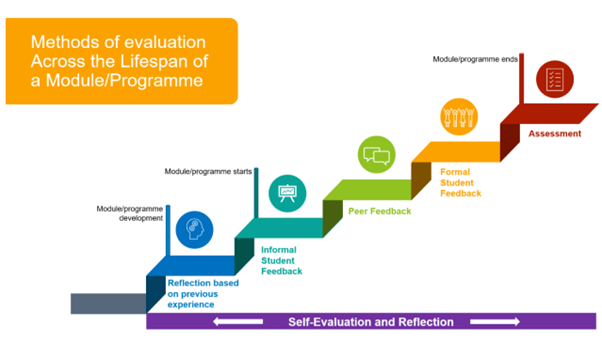
There are many moments where reflection could be prompted in the Academic cycle:
- Prior to the start of the module or programme;
- Before, during or after a teaching session;
- Through formal and informal interactions with students or colleagues;
- Following formative or summative assessment of student work;
- Through the PDR process;
- During points in the quality assurance processes (for example: at examining boards, boards of studies, following module enhancement, after student surveys, in review and revailidation)
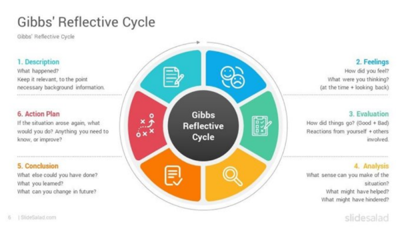
There are a range of models for reflection, to help you evaluate your approach to teaching. Consider Gibbs’ (1988), reflective cycle, which sets out a 6-stage approach to reflecting experiences. Alternatively, Paul Ashwin’s ‘Reflective Teaching in Higher Education’ (Ashwin, 2020) provides a comprehensive overview of how reflection can support all aspects of your role as a teacher.
Considerations for programme and module evaluations, and using formal mechanisms such as the National Student Survey for evaluations are in other pages of this toolkit. Here we will consider some informal evaluation tools for session level design and teaching.
There are a range of evaluation tools and strategies to support teachers to evaluate the practice. There is a useful list created by the University of Oxford, and below is a list of frequently used informal evaluation tools:
- 2 Stars and a Wish: Two positive aspects and one suggestion for improvement.
- Stop, Start, Carry On: Identify actions to stop, start, and continue.
- Minute Papers: Quick reflections on learning and outstanding questions.
- Muddiest Point: Identifying confusing aspects to target clarification.
- Think-Pair-Share: Collaborative discussions that enhance engagement.
- Anonymous surveys: Encourage honesty and inclusivity by collecting insights confidentially, via mentimeter or padlet
It is essential we do not treat the diverse student body as if their experience of your teaching is unanimous. It is important to ensure you gather the views of different groups of students. Below are some recommendations for considering diversity in evaluations:
1.Inclusive Design
- Ensure questions are open-ended and allow for diverse perspectives.
- Gather student characteristics to enable analysis of diverse perspectives
- Avoid jargon or culturally specific references that may not be understood by all students.
2. Anonymity and Confidentiality:
- Use anonymous feedback tools to encourage honest responses from all students, especially those from underrepresented groups.
3. Multiple Feedback Channels:
- Provide various ways for students to give feedback (e.g., written, verbal, digital) to accommodate different communication preferences and abilities.
4. Cultural Sensitivity:
- Be aware of cultural differences in communication styles and feedback preferences.
- Adapt evaluation methods to be respectful and inclusive of all cultural backgrounds.
5. Regular Reflection and Adjustment:
- Continuously reflect on the feedback received and adjust teaching methods to better meet the needs of a diverse student body.
- Engage in professional development on inclusive teaching practices
Action Research
Action research is a methodology for small-scale inquiry-based research, with student voice at the centre, and therefore is an ideal model for actively seeking, listening to and responding to diverse voices, to make improvements to practice.
Action research is a type of scholarship inquiry that is:
- Practical as it involves making change to practice
- Theoretical as it is informed by theory and can generate new insights
- Concerned with change and improvement.
Action research is a methodology; that is a framework for approaching a piece of research. Action researchers believe, or adopt a position, which says the world can be seen differently from different perspectives. They try to understand and make improvements to practice in an environment where there are probably many viewpoints. It is not viewed as generalizable but is shared with others through publication, for who might want to engage in similar changes to practice (Boucher and Piderit 2017).
Student voice is a central form of data in action research, with semi-structured interviews, observations, focus groups, informal interviews, and questionnaires. You may also use reflections on your own practice, attainment and attendance data, observations, and artefacts (such as student assessment work or forum posts).
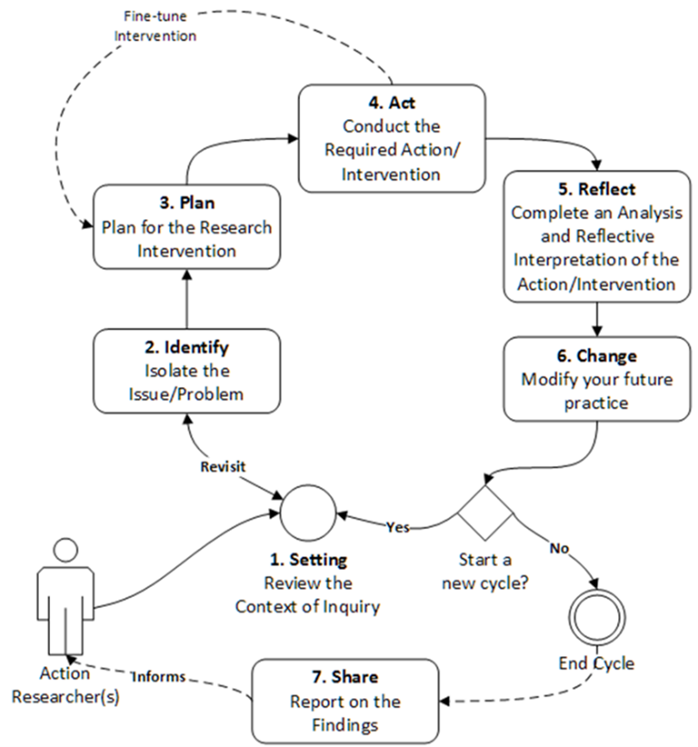
There are a number of distinct stages of action research, as illustrated below:
Where next?
Link to other toolkit pages
Our three key areas of focus of Fostering a Sense of Belonging, Empowering Students to Fulfil their Potential, and Developing Inclusive Mindsets are in the Inclusivity themes section of this toolkit. You can go on to read more about Evaluation, Student Engagement, collaboration and co-construction in the rest of this section.
Additional resources and references
Ashwin, P (2020) ‘Reflective Teaching in Higher Education’ London: Bloomsbury. Available at: https://www.vlebooks.com/Product/Index/1826737
Boucher, Duane & Piderit, Roxanne. (2017). Application of an Action Research Process: Reflections on an Undergraduate Information Systems (IS) Software Development Project (SDP).
Gibbs G (1988). ‘Learning by Doing: A guide to teaching and learning methods’. Oxford: Further Education Unit. Oxford Polytechnic.
QAA. 2018. Expectations and Practices for Learning and Teaching. (Online) Available at: https://www.qaa.ac.uk/the-quality-code/2018/advice-and-guidance-18/learning-and-teaching#
University of Oxford. 2025. Methods to evaluate your teaching. Available at: https://www.ctl.ox.ac.uk/methods-evaluate-teaching
Page Authored by: Cardiff University Learning and Teaching Academy: Dr Ceri Morris