Learning Design in Practice: Designing effective flipped learning
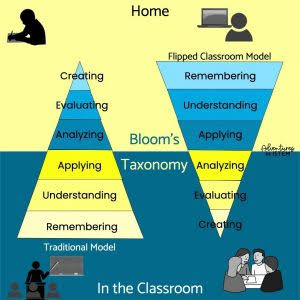
This page introduces you to the concept of flipped learning, which is effective to enable students to use pre-class activities to prepare for higher-order learning during class. The focus is on designing pre-session tasks that introduce key concepts, leaving valuable class time for discussion, problem-solving and application. This helps students arrive better prepared and creates opportunities for deeper learning. It is for those who want to know more about using a flipped, ‘blended’ approach in their teaching, whatever their role.
Aligned to PSF: V2, K1, K4, A2
You can develop your understanding of by engaging with our related workshops, ‘Create Engaging Video Content (using Panopto), and Create Interactive Resources (using Xerte). Find out more on the Cardiff LTA CPD page.
The Evidence for Flipped Learning
Some of the benefits of flipped learning are self-evident. For instance, freeing up time from delivering materials means that more time can be allocated to other valuable activities, such as skill development, assessment literacy development or the exploration of graduate attributes. Flipped learning may also offer more opportunities to have meaningful (e.g. social, applied, experiential) synchronous learning experiences simply by creating more space in the curriculum.
The experience of flipped learning sees students in contact with many aspects proven to aid learning, such as an active and responsive learning environment, pre-learning materials and peer collaboration and feedback (Hamden et al., 2013; McLaughlin et al., 2014; Freeman et al., 2014).
Practical tips
- Keep pre-class activities purposeful and manageable (around 20-30 minutes where possible).
- Give students choice and flexibility with pre-class activities. For example, read an article or watch a video to prepare for the synchronous session.
- Align pre-class activities with the intended learning outcomes.
- Use a short quiz or reflective questions to check understanding before class.
- Design in-class activities that require learners to apply, discuss or evaluate and not simply repeat the pre-class content.
- Explain to students why the flipped approach is being used and how it will benefit their learning.
- Set clear expectations for pre-class activities and in-class participation, especially when you are using flipped learning with a group for the first time.
Resource
In the following video, Alex introduces the basic concepts and benefits of flipped learning.
Download: Flipped Learning Planning Checklist
Download: Flipped Learning FAQs