Inclusive Design
Providing learning that is authentic, meaningful and relevant by recognising the needs and perspectives of all learners, and designing for all
Inclusive design of our programmes, modules or teaching sessions is essential to ensure we are providing learning that is authentic, meaningful and relevant, by recognising the needs and perspectives of all learners, and designing for all. On this page you will read about how you can support all learners in Higher Education, using the principles of inclusive, universally designed learning opportunities. It is for anyone who is teaching or supporting students, in any role.
Inclusive design aligns to the Professional Standards Framework (PSF 2024) overall requirement for ‘effective and inclusive practice’, and in particular to Professional Values V1: Respecting individual learners and groups of learners, and V2: promoting engagement in learning and equity of opportunity. It is central to A1: ‘Design and plan learning activities and/or programmes’. It also enables application of K1: ‘How learners learn’, and K2: ‘Approaches to teaching and/or supporting learning’.
The Cardiff University Inclusive Education Enhancement Model has a series of key targets for enhancing design which draw on research and sector recommendations.
Enhancement Model Targets for Design:
- Learning and assessment is student-centred and interactive, promoting on-going opportunities for students to make choices about the curriculum, teaching approaches and assessment practices.
- There are learning opportunities on all modules and assessments on the programme where students bring their own experiences to learning related to diversity and inclusion issues or local or international communities
- Modules have taught sessions that use images, verbal or text scenarios or examples, and case studies that highlight or draw upon diverse characteristics.
You can develop your understanding of Inclusive Education by engaging with our related workshops, which are available asynchronously, to take in your own time, and can be followed by a live workshop (with enough demand), or a bespoke meeting with the lead to discuss application to your practice. Find out more on the Cardiff LTA CPD page.
Designing for all of our diverse students is central to Cardiff University’s Strategy, ‘Our Future, Together’.
Key Principles of inclusive, universal design for learning
Learners differ markedly in what sparks their motivation and enthusiasm for learning, and how they are able to engage with learning. Learners must also be able to bring their authentic selves to the learning environment and find connections to what matters most in their lives. Learners also differ in the ways they perceive and make meaning of information. We must consider how people access information, and how people, cultures, individual and collective identities and perspectives are represented within the content (CAST 2023).
When planning a teaching session or series of teaching sessions, plan to use a range of teaching strategies: there is no one approach that is inclusive for all learners, as every activity will advantage some, and disadvantage others. We tend to employ ‘folk pedagogy’ where we teach how we have been taught, and which have benefitted us as learners.
For example, a common activity in sessions is small group discussions with feedback to the larger group, which enables social, constructivist learning, and builds team working skills. However, some learners might struggle to interact in this process, due to neurodivergence, anxiety or cultural experiences of learning, if they have previously studied in different, more didactic settings. Some might therefore benefit from some time completing individual, silent reflection activities, or use of digital feedback mechanisms, such as mentimeter or padlet. Some may require clear explanations of expectations for active learning.
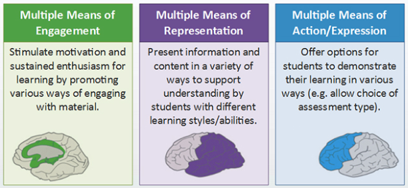
Moriarty (2016) suggests that the principles of UDL prompt institutions to embed anticipatory adjustments in the design of curricula that are flexible, adaptable to multiple forms of engagement and therefore facilitate all student learning. These anticipatory adjustments, by their very nature, apply to ALL students: ‘What is essential for some students is beneficial for all’.
When planning your session, or series of sessions, plan for multiple means of engagement, representation and action and expression: you can do this within the same activity, for example, by welcoming feedback on the activity in text or oral form, or across a series of activities, by having one group work, one individual task and one digital response activity within a session. You can also ensure asynchronous engagement for those who cannot attend. In this way the variety of needs of your diverse learners can be met.
| Duration/Time | Teaching strategy and content |
Student Activity |
| 10 mins | Introduction: Teacher talk | Listen and take notes (didactic teaching of core content, slides, readings and notes available in advance and afterwards) |
| 20 mins | Group activity: Apply talk to practice | Group discussion with feedback via oral presentation or mentimeter (social learning with choice of feedback mode, available asynchronously) |
| 10 minutes | Introduce individual activity: Silent reflection and 1 minute summary | Listen to or read introduction to task, reflect and write 1 minute summary (choice of modes for instructions for activity) |
| 10 minutes | Conclusion: Mentimeter Quiz and summary | Complete quiz online (multi-media for range of activities, can be completed asynchronously) |
For further reading: Bale and Seabrook (2021) consider a range of inclusive teaching strategies in their book ‘An introduction to university teaching’, including small and large group teaching, lab work, fieldwork and digital education.
Culturally Sustaining Pedagogy
The students in our classrooms arrive with a diverse set of learning needs and a range of cultural experiences and identities. Learning must be looked at within the context and the culture in which they occur. Culture has been defined in many ways, for example, ‘shared patterns of behaviours and interactions, cognitive constructs, and affective understanding that are learned through a process of socialization. These shared patterns identify the members of a culture group while also distinguishing those of another group’ (Hanesworth et al. 2019: 1)
Multiple levels of awareness are necessary for teachers to be culturally responsive. This includes knowledge of personal biases, students’ backgrounds/strengths, how the learning environment should build from students’ strengths; and how to bring about change in education systems.
Teaching using UDL is further enhanced when acknowledging how race, cultural, and linguistic differences could affect students’ learning (Kieran and Anderson 2019). The Universal Design for Learning guidelines (CAST 2024), version 3.0, incorporate culturally sustaining pedagogies.
Where next?
Link to other toolkit pages
Our three key areas of focus of Fostering a Sense of Belonging, Empowering Students to Fulfil their Potential, and Developing Inclusive Mindsets are in the Inclusivity themes section of this toolkit.
Additional resources and references.
CAST 2024. Universal Design for Learning Guidelines version 3.0. Online. Available at: http://udlguidelines.cast.org
Hanesworth, P. Seán Bracken & Sam Elkington (2019) A typology for a social justice approach to assessment: learning from universal design and culturally sustaining pedagogy, Teaching in Higher Education, 24:1, 98-114
Hockings, C. 2010. Inclusive Learning and Teaching in Higher Education: A Synthesis of Research. York: Higher Education Academy.
Kieran, L. and Anderson, C. 2018. Connecting Universal Design for Learning With Culturally Responsive Teaching. Education and Urban Society 2019, Vol. 51(9) 1202–1216
Moriarty, A. and Scarffe, P. 2019. Universal Design for Learning and Strategic Leadership. In: Bracken, S. and Novak, K. Transforming Higher Education through Universal Design for Learning: An international perspective. Abingdon, Oxon: Routledge