Learning Design in Practice: Designing beyond blended. Using the Six Pillars
The Jisc Beyond Blended framework (Beetham and McGill 2025) encourages educators to move beyond thinking simply about online versus face-to-face delivery. Instead, it focuses on designing learning experiences around six key pillars: Place, Platform, Pace, Blend, Flex and Support. These pillars help curriculum teams make intentional decisions about where, when and how learning takes place, ensuring that learning experiences are pedagogically meaningful, inclusive and responsive to student needs. These concepts are introduced below, and in the useful Beyond blended pillars: strategic lenses prompts and questions document.
This page introduces you to the Six Pillars, and designed for anyone who wants to know more about the developments in approaches to learning beyond the boudaries of face-to-face verses digital or blended learning.
Aligned to PSF: V1, V2, K4, A1-4
You can develop your understanding of moving beyond Blended by engaging in our series of workshops. Find out more on the Cardiff LTA CPD page.
The Six Pillars of Beyond Blended Design
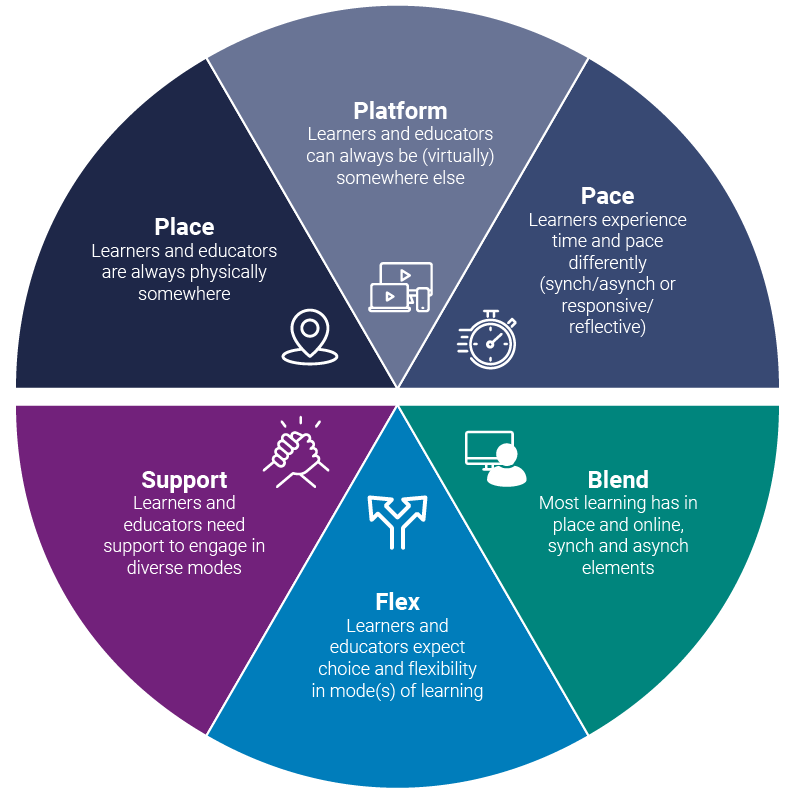
The Beyond Blended framework proposes six interconnected pillars that help educators think strategically about curriculum and learning design. Rather than starting with technology or mode of delivery, the framework encourages teams to consider how students participate in learning across different spaces, times and contexts.
Place
Consider where learning happens and the educational value of different learning spaces. In-place and online environments offer distinct opportunities for engagement, interaction and participation.
Platform
Students increasingly navigate multiple digital environments. Effective design requires thoughtful decisions about which platforms are used, how they connect and how students access learning materials and activities.
Pace
Learning takes place across both synchronous and asynchronous time. Students may require support to manage independent learning effectively, making clear expectations and structured learning pathways essential.
Blend
A beyond blended approach considers the relationship between different learning modes and activities. The emphasis is not on replicating face-to-face teaching online, but on combining modes in ways that maximise learning value.
Flex
Students have diverse circumstances, preferences and needs. Providing appropriate flexibility around participation, access and learning pathways can improve engagement and support student success.
Support
Students need clear guidance, effective communication, accessible resources and timely feedback. Support structures should help learners navigate both the curriculum and the choices available to them.
Together, these six pillars provide a shared vocabulary for discussing curriculum design and help educators create learning experiences that are responsive, engaging and fit for a rapidly changing higher education environment.
Practical tips
- Consider whether activities are best undertaken in place, online, or through a combination of both.
- Select digital platforms that support the learning outcomes rather than adding technology for its own sake.
- Be explicit about pace, helping students understand how synchronous and asynchronous activities fit together.
- Design the blend of learning activities deliberately, recognising that different modes support different types of engagement.
- Build in appropriate flexibility while maintaining clear academic expectations.
- Provide guidance to help students make informed choices about participation and engagement.
- Ensure students understand the value of attending and participating in different learning activities.
- Design asynchronous activities with the same care as live sessions.
- Gather student feedback on how different modes of participation support their learning.
- Review modules periodically against all six pillars to identify opportunities for enhancement.
Where next?
Engage in our CPD workshops on assessment and feedback to broaden your understanding and apply it to your design and delivery of assessment.
Additional resources
Beetham et al. 2025. Beyond blended: rethinking curriculum and learning design (Online). JISC. Accessed 12/10/2026
Beyond blended pillars: strategic lenses prompts and questions