This page will explain how the 9 Skills for Success have been created to align with Cardiff University’s Our Future, Together strategy, supporting our commitment to ‘offer flexible, tailored, lifelong learning that gives students choice, agency and a voice, and equips them with future‑proofed knowledge and skills they can apply in the real world to fulfil their aspirations’. It will ensure that through our teaching, learning and wider student experience, our students will develop into ‘resilient, critical, problem-solving change makers who know how to work together in an uncertain, interdisciplinary, cross-sectoral, digitised world’.
It is designed for those who want to know more about the Cardiff University approach to Employability, for those who are teaching and working at an Associate Fellow, Fellow or Senior Fellow level.
Aligned to PSF: V4 K5 A4
You can develop your understanding of Employability by engaging with our related workshop, ‘Authenticity and Employability in Curriculum Design’. Find out more on the Cardiff LTA CPD page.
Shifting from Graduate Attributes to Skills for Success
Access the video transcript.

Participating in the employer focus groups for Cardiff University’s 9 Skills for Success was a fantastic opportunity to collaborate on shaping future graduate talent. These nine core skills perfectly reflect exactly what we look for - particularly the emphasis on being adaptive, inclusive, and professionally minded in an ever-changing landscape. It is highly encouraging to see a university framework so actively and practically aligned with modern employer needs.
The skills were:
- Developed by the Graduate Attributes Review Working Group, chaired by the Pro-Vice Chancellor, Education and Student Experience, following extensive literature reviews, internal and external benchmarking, academic and professional services consultation, widespread student involvement and employer engagement; and
- Refined through consultation and feedback with the Graduate Attributes Review Task & Finish Group and on-campus student testing; and
- Supported and approved by the Education and Student Experience Committee (ESEC) in May 2026 as a replacement for the six Graduate Attributes
What: 9 Skills for Success

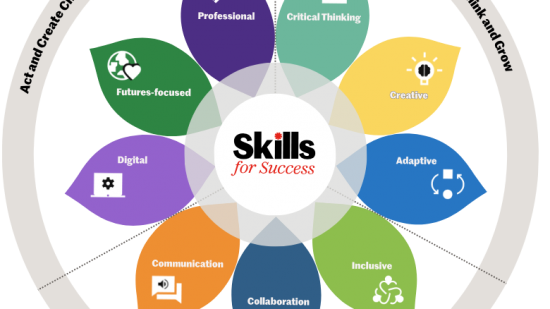
The 9 Skills and Sample Capabilities:
We are using the title ‘Sample Capabilities’ to introduce and explain the criteria of each skill. You will find the sample capabilities listed under each of the 9 skills.
Adaptive
-
-
- be flexible, agile and find opportunities in change, responding constructively to challenges with emotional intelligence and resilience
- reflect on learning and experiences to recognise own strengths, self-development needs and set goals
- manage time effectively and take proactive steps to support personal wellbeing
-
Collaboration
-
-
- work effectively with others respecting and learning from different perspectives
- contribute and lead within groups fostering cooperation and managing conflict
- engage in opportunities to build professional networks and positive relationships
-
Communication
-
-
- demonstrate active listening
- convey meaning and messages effectively using evidence and appropriate methods such as public speaking and storytelling to engage others
- present ideas with confidence
-
Creative
-
-
- develop original ideas and approaches through curiosity, imagination and innovation
- explore possibilities, experiment with established ways of working and learn from challenges
- apply creativity, design, ingenuity or practice to generate impactful solutions
-
Critical Thinking
-
-
- develop independent thought by questioning assumptions and practices
- analyse a range of information, data and scenarios, applying logical reasoning and problem‑solving to make informed decisions.
- use research and evidence critically with awareness of bias
-
Digital
-
-
- develop awareness and understanding of digital tools and technologies, adapting to technological advances
- apply digital skills to improve ways of working, process information effectively, and make a positive difference
- consider the ethical implications of digital practice, engaging safely and responsibly with emerging technologies
-
Inclusive
-
-
- respect, value and learn from different cultures, diverse communities and demonstrate an openness to global perspectives and local initiatives
- apply ethical judgement to assess the impact of actions
- embrace Welsh language, culture and context
-
Futures-focused
-
-
- consider the long‑term impact of actions and decisions
- act with social, environmental and economic responsibility
- make informed choices that contribute to sustainable and positive futures
-
Professional
-
-
- demonstrate curiosity and commercial awareness, showing initiative and motivation to learn and develop
- behave with integrity, reliability and accountability
- apply learning and discipline-specific knowledge confidently and effectively to add value in professional environments
-
You can download a Word document of these capabilities here.
Why: The rationale for change
Across higher education, government, professional bodies and employers, there has been a noticeable shift towards the language of skills as a way of describing the capabilities students need to develop to succeed in an increasingly complex and rapidly changing world. Organisations such as the Office for Students (OfS), Medr, QAA, the Institute of Student Employers (ISE) and the World Economic Forum increasingly emphasise the importance of skills development, employability and future workforce capability, reflecting a growing focus on what learners can do, apply and demonstrate alongside what they know. The emergence of skills taxonomies and skills-based approaches further highlights the growing importance of a shared language for describing, developing and evidencing capability.
While academic knowledge and disciplinary expertise remain central to the university experience, there is increasing recognition that success after graduation depends on a combination of qualifications, skills, behaviours and experiences. Employers continue to value subject knowledge, but consistently highlight the importance of broader capabilities such as communication, collaboration, digital confidence, problem solving, adaptability and professional awareness. In this context, developing skills is no longer viewed as an additional benefit of higher education, but as a core element of preparing graduates for employment, further study and lifelong learning.
The new Skills for Success have been meticulously analysed to make sure they can be relevant and applicable to every school within our university.
Student expectations are also changing. As students increasingly consider the value and outcomes of their university education, they are placing greater emphasis on employability, career readiness and the ability to translate their learning into future opportunities. Many students are as interested in the skills, experiences and opportunities they will gain as they are in the content of their degree programme. A clearer focus on skills helps students to recognise, articulate and evidence their development throughout their time at Cardiff University.
Consultation undertaken as part of the Graduate Attributes Review reinforced this direction of travel. Students, employers and staff consistently responded more positively to the language of skills than graduate attributes. Students found the concept easier to understand, more relatable and more relevant to their future aspirations, while employers felt it better reflected the capabilities they seek in graduates entering the workplace. The move to the 9 Skills for Success therefore represents not only a change in language, but a more accessible, engaging and externally aligned way of supporting and recognising student development.
Staff, students and employers were all consulted in this refresh of graduate attributes. Bringing together the priorities from all 3 groups which is key to a relevant, reflective and purposeful education.
How: Integrating 9 Skills into the student experience
The 9 Skills for Success will be embedded across the curricular, co-curricular and extracurricular student experience, supported by a range of resources, activities and development opportunities. This work forms part of the wider Skills for Success project, with Curriculum 2035 leading curriculum integration and Student Futures coordinating implementation and support.
The new 9 Skills for Success provide a clear and practical framework that helps students recognise and reflect on the skills they're developing throughout their degree. They also give academics a shared language for embedding those skills more intentionally across our programmes, ensuring students have opportunities to develop the capabilities that will support them during and beyond university.
The 9 Skills for Success will be introduced through programme approval and revalidation during 2026–27, before being fully rolled out across the University at the start of the 2027–28 academic year.
Where next?
Further information can be found in the following sections:
Who to contact for further information:
Business Lead: Jon Forbes, ForbesJ3@cardiff.ac.uk.
If you would like further support or an opportunity to discuss the 9 skills framework please complete the 3 questions in the MS Form.