Programme approval and revalidation
This page introduces you to the core principles and areas of focus of addressing employability and the Skills for Success in Programme Approval and Revalidation. It is designed for those who are involved in programme design, approval and revalidation or for those who want to know more about the processes.
Aligned to PSF: V1, V2, V4, A1 K2
You can develop your understanding of Employability by engaging with our related workshop, ‘Authenticity and Employability in Curriculum Design’. Find out more on the Cardiff LTA CPD page.
The Programme Approval and Revalidation Process
Embedding employability into the curriculum presents an opportunity to enhance the student experience by designing exciting and engaging learning activities that develop a broader range of skills and attributes. It can support students to develop a greater appreciation of their subject discipline, engage in authentic experiences and better prepare them for the world of work. Moreover, it can help staff to future-proof their programmes, enhance NSS results and increase the number of graduates securing professional level outcomes.
To learn more about the institutional approach to employability please read our Student Futures Framework.
When developing new programmes, making changes to existing programmes or going through revalidation, Schools will need to consider how employability is embedded within their learning and teaching and demonstrate how the graduate attributes are integrated and surfaced to students.
As such, you will be required to complete an Employability and Skills Review, which you can access using the button below.
Employability and Skills Review Template
As members of the Programme Development Team, our role is to work with the academic sponsor and programme teams to complete the review and ensure all aspects of employability have been appropriately covered in the submission documentation.
Embedding the 9 Skills for Success
The 9 Skills for Success are a set of transferable skills, attributes and capabilities that Cardiff University has developed in partnership with students, academics and employers. These skills are intended to be a golden thread running through every student’s time at Cardiff and can be developed through their studies and via extra-curricular opportunities in their School, and across the wider university. By developing the 9 skills, students will maximise their chances of securing graduate-level employment as social, economic and environmentally aware global citizens.
If they are to be impactful, the 9 Skills for Success need to be visible to students and the significance of them understood. Graduate recruiters state that students often have a wealth of achievements and experiences, but they are not able to translate these into the skills and attributes that employers are looking for, and therefore they are not able to articulate them in their CV, LinkedIn profile, applications or at interview.
Many of the skills will already be embedded in academic programmes, so they need to be surfaced and acknowledged.
As part of your Employability and Skills Review, you will need to complete a Skills Mapping activity, as it will form part of your overall submission to the Programme Approval and Revalidation Sub-Committee. We recommend that you complete this activity after having undertaken a holistic review of employability on your programme and created your Programme and Module Learning Outcomes, which the Education Development Service can support you with. The Skills Mapping exercise can act as a useful self-audit once the majority of programme design has been completed.
The recommended approach is to map the skills and associated ‘sample capabilities’ against the learning, practice and assessments students will encounter on each module. Where gaps are identified, there may be options to embed additional, relevant activities into the programme, or to signpost the extra-curricular activities that students can undertake to develop the skills.
Before starting the mapping activity, it is important to be aware of several principles when considering how to map your outcomes and modules against the 9 Skills for Success:
Guiding Principles of Skills Mapping
Full rollout in 2027/28
The 9 Skills for Success will be introduced during 2026–27 only to staff involved in programme approval and revalidation. They will be fully launched to all staff and students from September 2027 and should not be shared with students before then. Early engagement with programme teams will ensure that programmes commencing from September 2027 are mapped to the 9 Skills for Success and use the new skills language from the outset, aligning with the University-wide rollout.
Business Partner support
A range of resources are being developed to support staff in embedding the 9 Skills for Success. These will be made available on the EDS Toolkit. In the meantime, colleagues seeking advice or support should contact their Student Futures Business Partner.
A 'Golden' Thread
The 9 Skills for Success are intended to be a ‘golden thread’ running through a student’s time at Cardiff, and have been devised, with input from employers, to maximise each student’s chances of securing graduate-level employment.
The Cardiff Commitment
The 9 Skills are not part of the ‘Cardiff contract’ with students, as the University is not guaranteeing that students will develop all of the skills as part of a programme of study. The commitment is that, through a range of curricular and extracurricular activities, students will have the opportunity to develop the skills during their time at Cardiff.
Asessment
There is no requirement that a skill has to be assessed, although the fact that it is assessed is likely to provide good evidence that the skill is embedded in a programme of study.
Institutional Commitment
There is no requirement for a programme to include exposure to all 9 Skills, as some may be gained through co-curricular and extracurricular activities. However, programmes should make a meaningful contribution to the development of the skills and reflect the University's commitment to supporting students to become social, economic and environmentally aware global citizens. While programmes may place greater emphasis on certain skills than others, they should not rely predominantly on extracurricular activity to deliver the University's skills agenda. Where skills are developed outside the curriculum, relevant opportunities should be clearly signposted to students.
Flexibility
The sample capabilities that sit under each Skill are only suggested ways in which the skills can be developed, and other options may be equally valid.
Postgraduate Programmes
Given their shorter duration, postgraduate taught (PGT) programmes may have less scope to support the development of the full range of skills, and in particular, vocational programmes are likely to be required to prioritise relevant professional practice skills.
Before submitting your completed template to the Programme Approval and Revalidation Sub-Committee, we recommend that you share it with your College Student Futures Business Partner for review. They can advise on the likelihood of it being approved by the Sub-Committee and/or support with further enhancements, if required.
Holistic Review of Employability Provision
Early in the programme approval and revalidation process, we recommend undertaking a holistic review of your employability provision. This could be by reviewing your existing programmes to understand if or where there are gaps, and/or by identifying what you want your future approach to look like when re-designing existing programmes or creating new ones.
We’ve suggested a 2-step guide to support your review:
Step 1: Review Key Metrics and Data
Graduate Outcomes: Use the Dashboard to understand what graduates from your programme have gone onto do and how your graduate outcomes performance compares to university KPIs.
Employability Dashboard: Speak to your College Business Partner to request key employability, placements and mobility data linked to your programme.
Career Readiness: Understand what support students from your School want in terms of careers support, work experience and entrepreneurship.
What do Graduates Do? guide: Use this Prospects guide to learn more about what graduate destinations across a wide range of sectors. This is particularly useful for those creating new programmes.
QAA Subject Benchmark Statements: These statements describe the nature of study and the academic standards expected of graduates in specific subject areas. They are written by subject specialists and show what graduates might reasonably be expected to know, do and understand at the end of their studies.
Step 2: Programme Review
To support programme teams in undertaking a holistic review of their employability provision, Student Futures has developed four Employability Threads that encapsulate the employability-related learning and activities that every student should be exposed to during their time at Cardiff. Where possible, the Threads should be woven into the curriculum, otherwise students should be signposted and actively encouraged to engage via extra-curricular activities.
The Employability Threads are illustrated below, but you can read more about them via the Student Futures Framework.
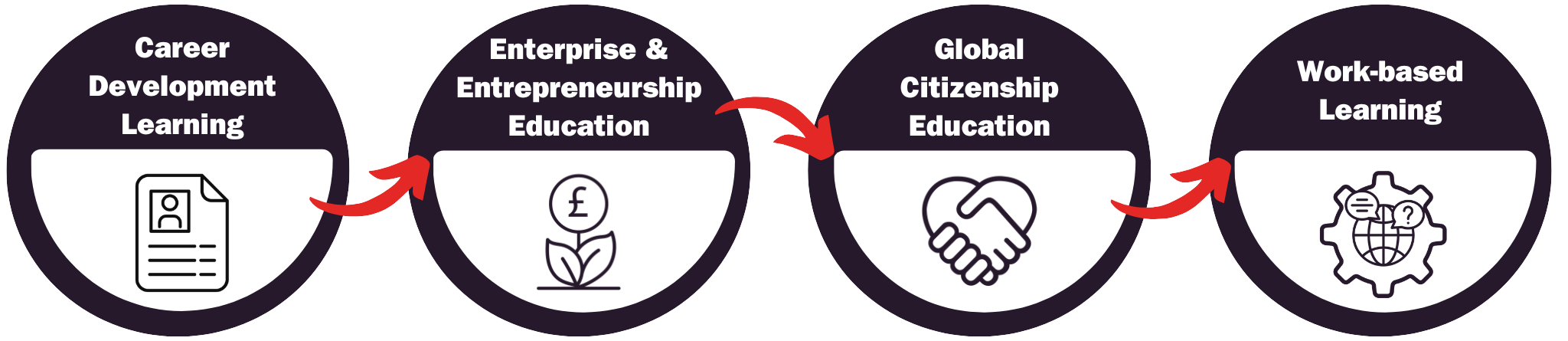
We have provided a resource that programme team leads could use to undertake a holistic review of your current approach to employability (if an existing programme) or help structure a new approach (if creating a new programme), which you can access using the button below. We would recommend conducting this review early on in the approval and revalidation process.